Carbajosa, one of the smallest and oldest villages in the Sobarriba region of León, holds an unexpectedly valuable heritage within its humble rural church. Just a few kilometers from León and located between Villalboñe and Villacil, the village treasures a splendid 16th-century Mudejar coffered ceiling, a 14th-century Gothic Christ, and a 16th-century Renaissance altarpiece by the masters Diego de Solís, Nicolás Pizarro, and Gregorio de Herreras. It also preserves a Gothic tympanum of the Virgin with Child and angels, possibly from the monastery of San Pedro de Eslonza. Additionally, a 12th-century Romanesque Virgin was once venerated here, now kept in the Cathedral Museum. Nestled in a silent, rural landscape, Carbajosa offers visitors a journey through time, where art and memory remain quietly alive.
Carbajosa, one of the smallest and oldest villages in the Sobarriba region of León, holds an unexpectedly valuable heritage within its humble rural church. Just a few kilometers from León and located between Villalboñe and Villacil, the village treasures a splendid 16th-century Mudejar coffered ceiling, a 14th-century Gothic Christ, and a 16th-century Renaissance altarpiece by the masters Diego de Solís, Nicolás Pizarro, and Gregorio de Herreras. It also preserves a Gothic tympanum of the Virgin with Child and angels, possibly from the monastery of San Pedro de Eslonza. Additionally, a 12th-century Romanesque Virgin was once venerated here, now kept in the Cathedral Museum. Nestled in a silent, rural landscape, Carbajosa offers visitors a journey through time, where art and memory remain quietly alive.
Located on the road from Villalboñe to Villacil, Carbajosa is undoubtedly one of the smallest villages in Sobarriba—not only in number of houses or inhabitants, which can fluctuate over time (and indeed has, though mostly downward), but also in what one perceives as its presence in the world, that visible or audible footprint left by what demands attention. Carbajosa does not impose itself. Rather, it allows itself to be, which is not the same.

The village appears early in documentation. On October 29, 1011, a certain Tendemiro (also called Ordonio) and his wife Domna donated two-thirds of a vineyard and lands—terras, as they said—to the priest Félix in what was already called Karvaliosa. Few places in Sobarriba can claim such an early date. In 1037, heirs and clerics disputed the possessions of the deceased Cristóbal. In 1144, Pedro Carvolen donated an estate that included San Martín and Carbajosa, as if the land knew no borders. And in 1466, Toribio Pérez sold meadows and plots for 1,900 maravedís, which the buyer later transferred to the Compañía de los Bachilleres. No one donates something without value. And Carbajosa’s value, however modest it may seem, lies in having always been a land of passage, of cultivation, of names.
What is striking is that none of this has made the village more visible. In the Marqués de la Ensenada Cadastre from 1753, there are seven registered neighbors. Seven. Eleven habitable houses, two in ruins. The priest—Juan López—has a housekeeper, a maid, two servants, and even a shepherd. The tithe is divided, as if the sacred could still be split. The priest’s beehives yield two reales a year. Taxes, rents, and services are paid to His Majesty. The total number of domestic animals would barely suffice for a small fair. Yet they remained: Fernando de la Puente, Bartolomé Fernández, Isidro, Pedro, José and Lorenzo Prieto, Juan de Llamazares… Names that appear in no digital registry today, but once were the only ones able to speak of that place.
It’s not that Carbajosa has remained outside of time, but time has passed over it like it passes over a stone object—without splintering it. It has left no visible cracks, but neither has it allowed forgetfulness. Perhaps that’s why the church still holds what it holds. Perhaps that’s why the crucified Christ still hangs there, untroubled. Because there are places that expect nothing—not redemption, nor judgment, nor salvation, nor ruin—and so they can afford to simply continue.
And to continue, at times, is a higher form of existence than any other.
Because there are villages that no longer ask for a future, but stubbornly remember they had a past. And in that silent memory lies their strength. And their mystery. And their resistance.
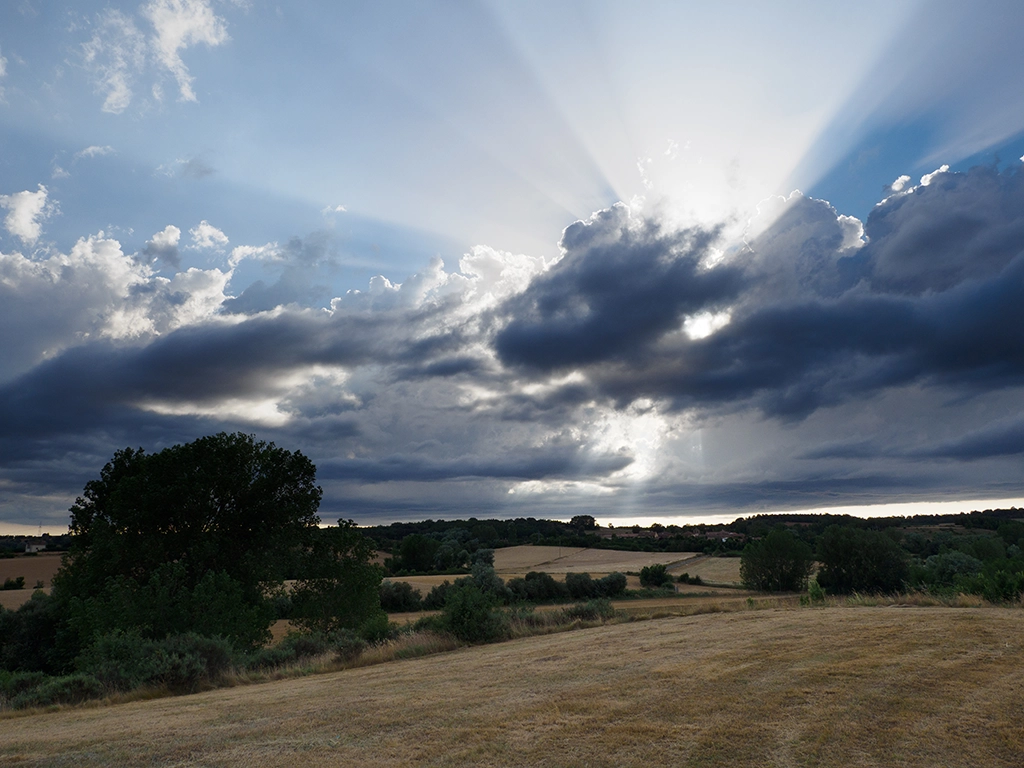
The village of Carbajosa belongs to the area known as Sobarriba, very close to the provincial capital on its eastern side. The village is organized into different streets, all beginning at the Church Square. The main street connects the village with the road that runs from León to Villafeliz. There is also a path to Santovenia. One kilometer from the village lies the cemetery, next to which stood a hermitage that burned down and collapsed, leaving no visible remains. Its location is now marked by a very tall cross, visible throughout the surrounding area.
Located on the road from Villalboñe to Villacil, Carbajosa is undoubtedly one of the smallest villages in Sobarriba—not only in number of houses or inhabitants, which can fluctuate over time (and indeed has, though mostly downward), but also in what one perceives as its presence in the world, that visible or audible footprint left by what demands attention. Carbajosa does not impose itself. Rather, it allows itself to be, which is not the same.
The village appears early in documentation. On October 29, 1011, a certain Tendemiro (also called Ordonio) and his wife Domna donated two-thirds of a vineyard and lands—terras, as they said—to the priest Félix in what was already called Karvaliosa. Few places in Sobarriba can claim such an early date. In 1037, heirs and clerics disputed the possessions of the deceased Cristóbal. In 1144, Pedro Carvolen donated an estate that included San Martín and Carbajosa, as if the land knew no borders. And in 1466, Toribio Pérez sold meadows and plots for 1,900 maravedís, which the buyer later transferred to the Compañía de los Bachilleres. No one donates something without value. And Carbajosa’s value, however modest it may seem, lies in having always been a land of passage, of cultivation, of names.
What is striking is that none of this has made the village more visible. In the Marqués de la Ensenada Cadastre from 1753, there are seven registered neighbors. Seven. Eleven habitable houses, two in ruins. The priest—Juan López—has a housekeeper, a maid, two servants, and even a shepherd. The tithe is divided, as if the sacred could still be split. The priest’s beehives yield two reales a year. Taxes, rents, and services are paid to His Majesty. The total number of domestic animals would barely suffice for a small fair. Yet they remained: Fernando de la Puente, Bartolomé Fernández, Isidro, Pedro, José and Lorenzo Prieto, Juan de Llamazares… Names that appear in no digital registry today, but once were the only ones able to speak of that place.
It’s not that Carbajosa has remained outside of time, but time has passed over it like it passes over a stone object—without splintering it. It has left no visible cracks, but neither has it allowed forgetfulness. Perhaps that’s why the church still holds what it holds. Perhaps that’s why the crucified Christ still hangs there, untroubled. Because there are places that expect nothing—not redemption, nor judgment, nor salvation, nor ruin—and so they can afford to simply continue.
And to continue, at times, is a higher form of existence than any other.
Because there are villages that no longer ask for a future, but stubbornly remember they had a past. And in that silent memory lies their strength. And their mystery. And their resistance.
The village of Carbajosa belongs to the area known as Sobarriba, very close to the provincial capital on its eastern side. The village is organized into different streets, all beginning at the Church Square. The main street connects the village with the road that runs from León to Villafeliz. There is also a path to Santovenia. One kilometer from the village lies the cemetery, next to which stood a hermitage that burned down and collapsed, leaving no visible remains. Its location is now marked by a very tall cross, visible throughout the surrounding area.
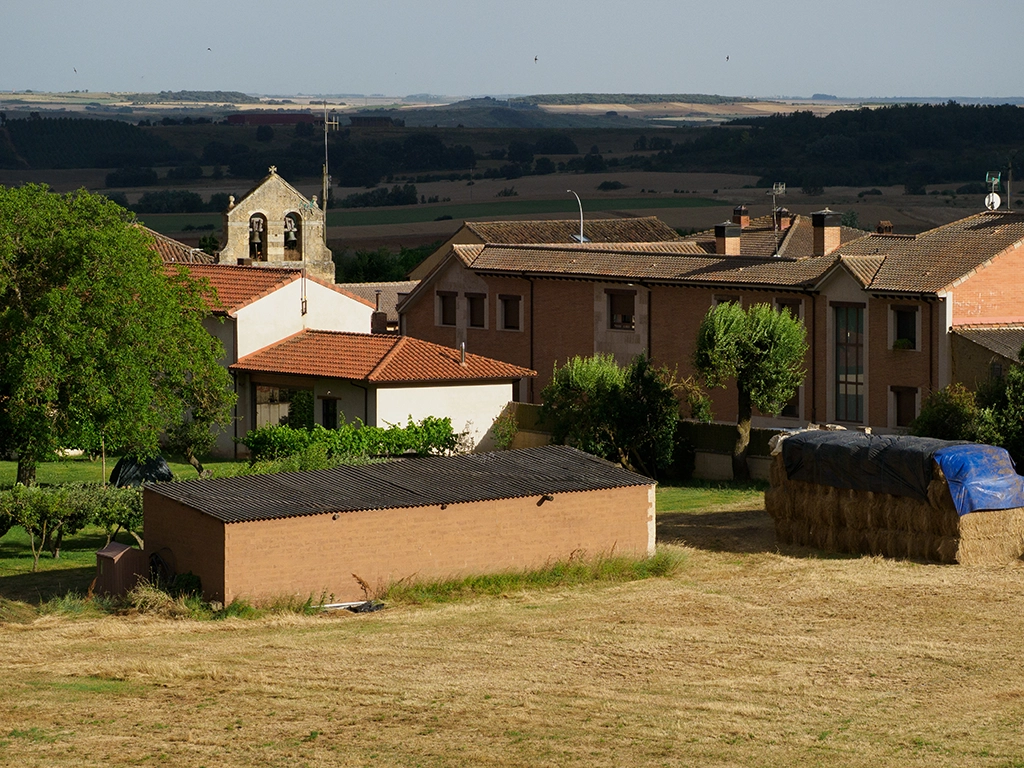
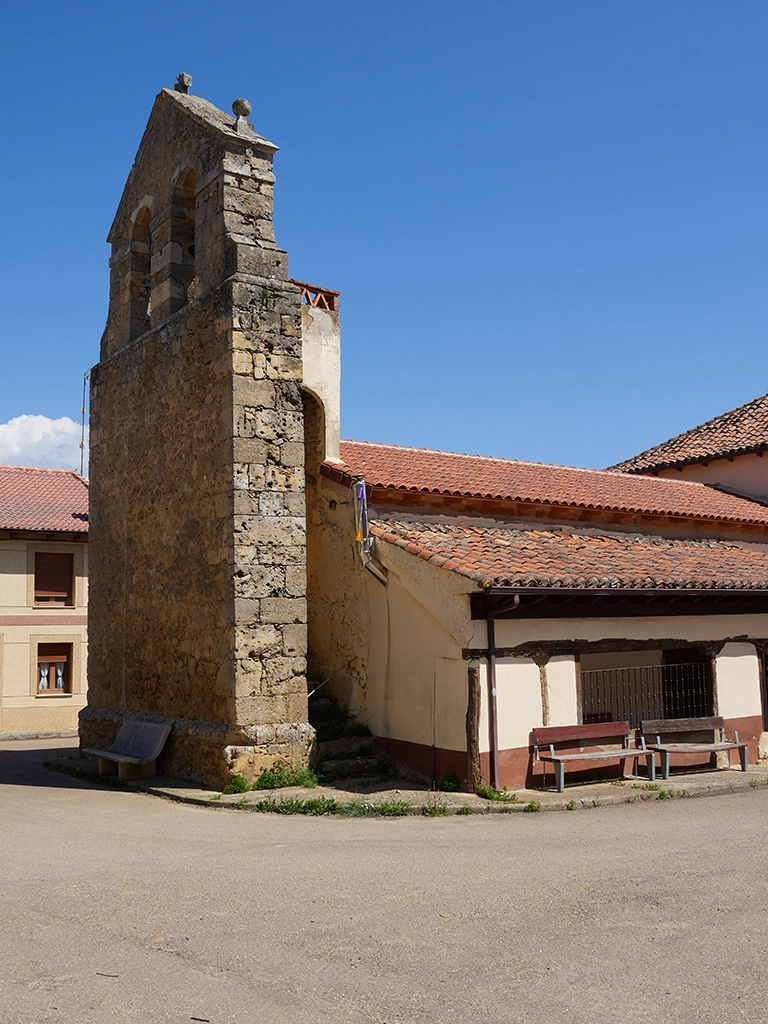
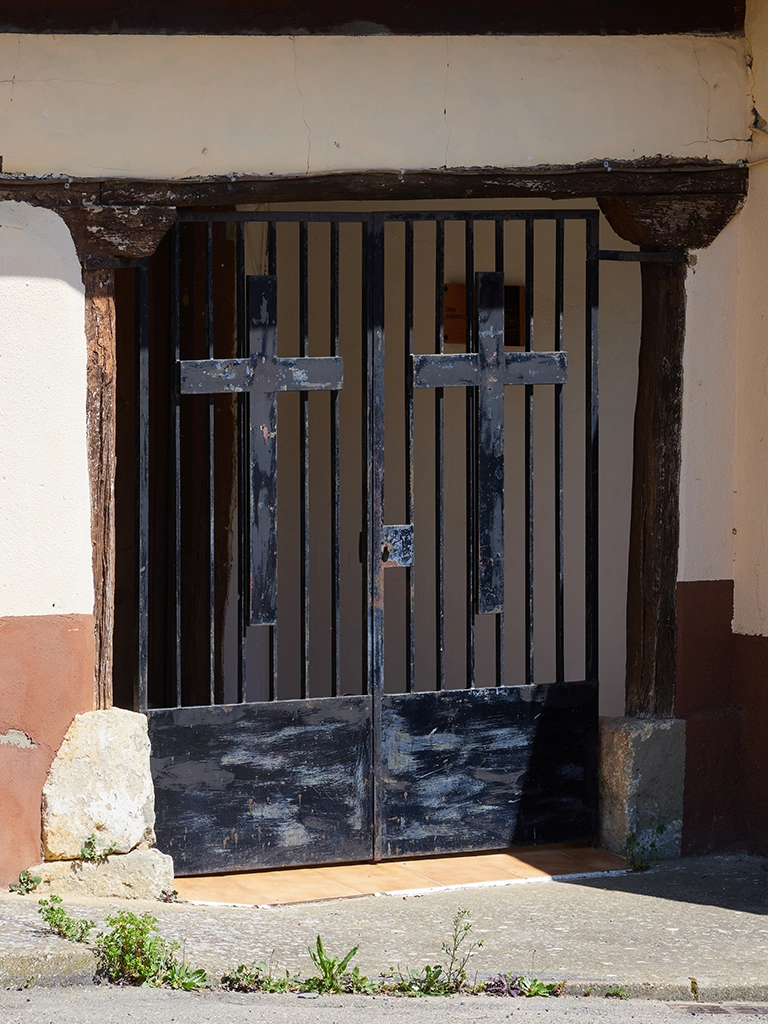
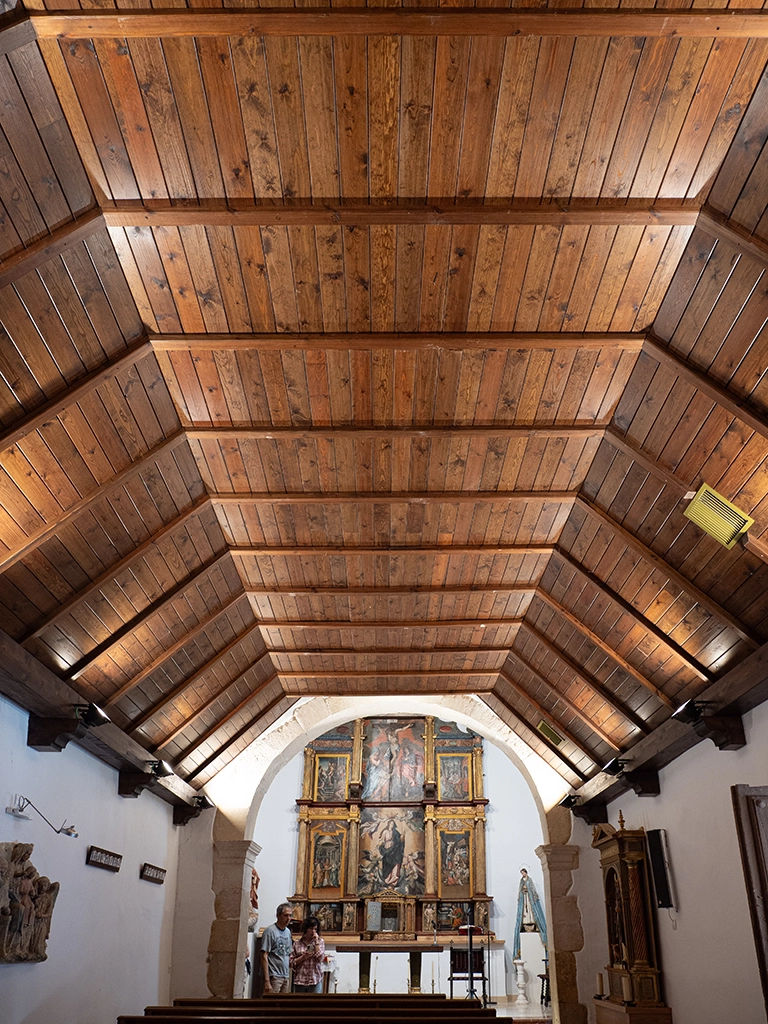
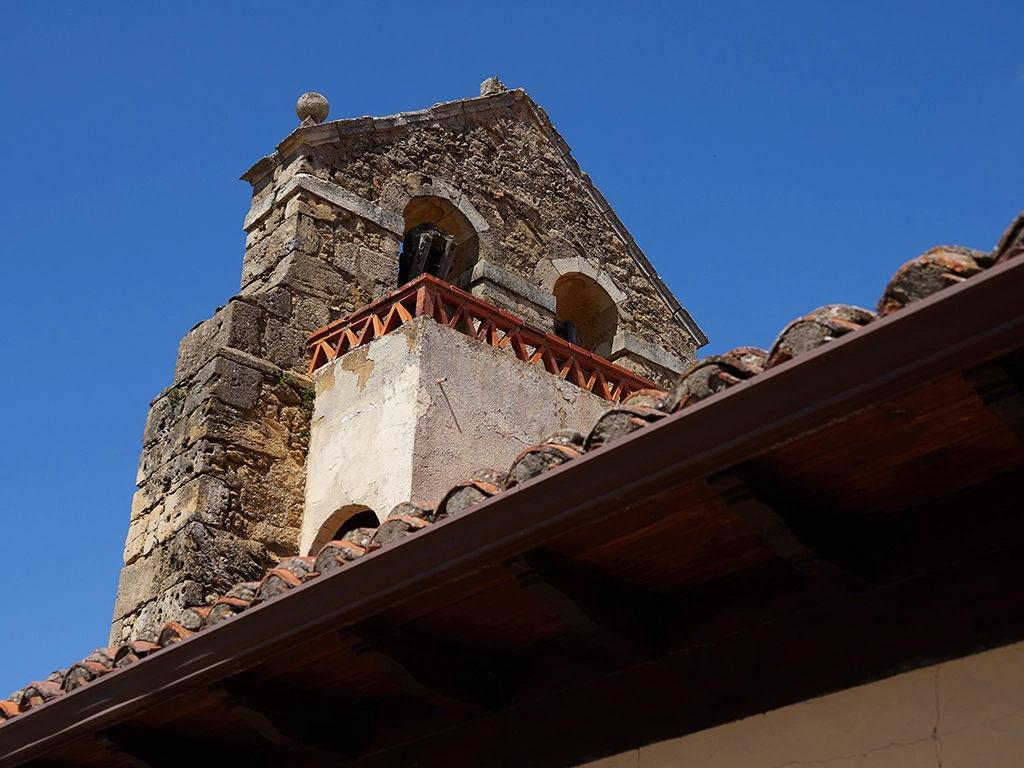
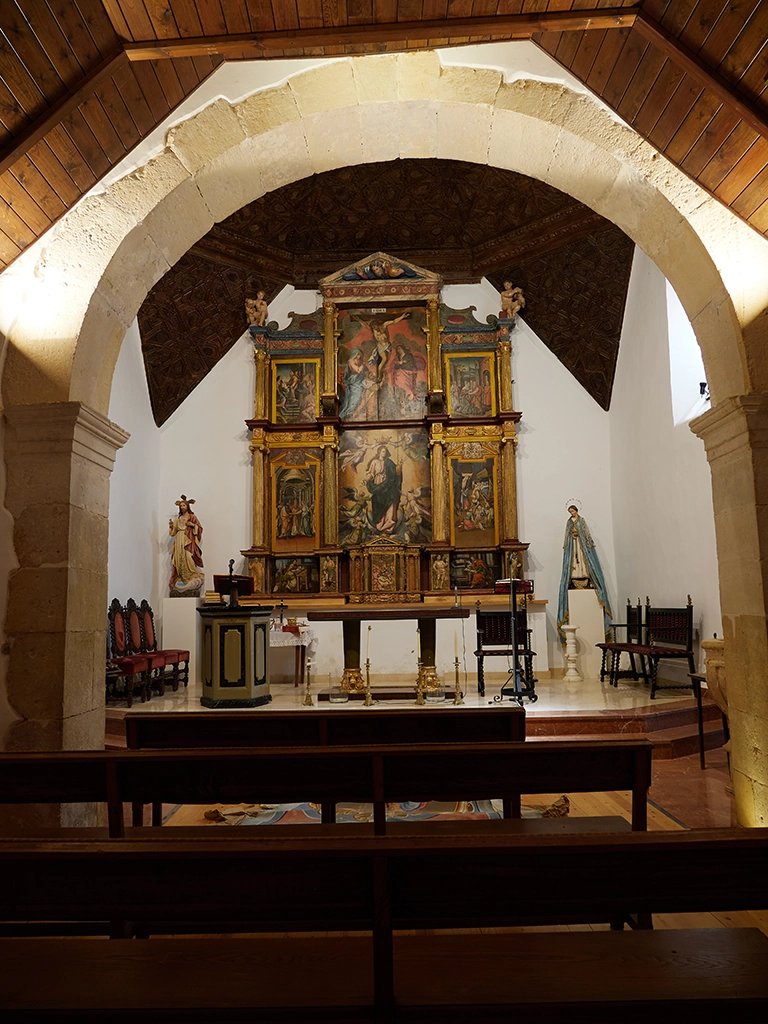
The church consists of a single rectangular nave and an elevated square apse, separated from the nave by a fairly tall semicircular arch, and with a side entrance in the center of the nave through a covered atrium. Attached to it is a bell gable built in stone, whose bells are accessed via an external staircase of later construction.
This church has undergone several restoration and conservation efforts since the late 20th century. The first focused on restoring the Mudejar coffered ceiling. The second restored the tabernacle. The third restored the lower bench of the altarpiece. The fourth restored the entire altarpiece. The fifth replaced the floorboards, painted the walls, and installed a false wooden ceiling imitating an inverted ship structure to replace the former reed and plaster ceiling. In 2024, after the collapse of the central nave roof, it was restored. During the work, fresco remains were discovered on the arch separating the apse, now covered by the interior false ceiling of the nave.
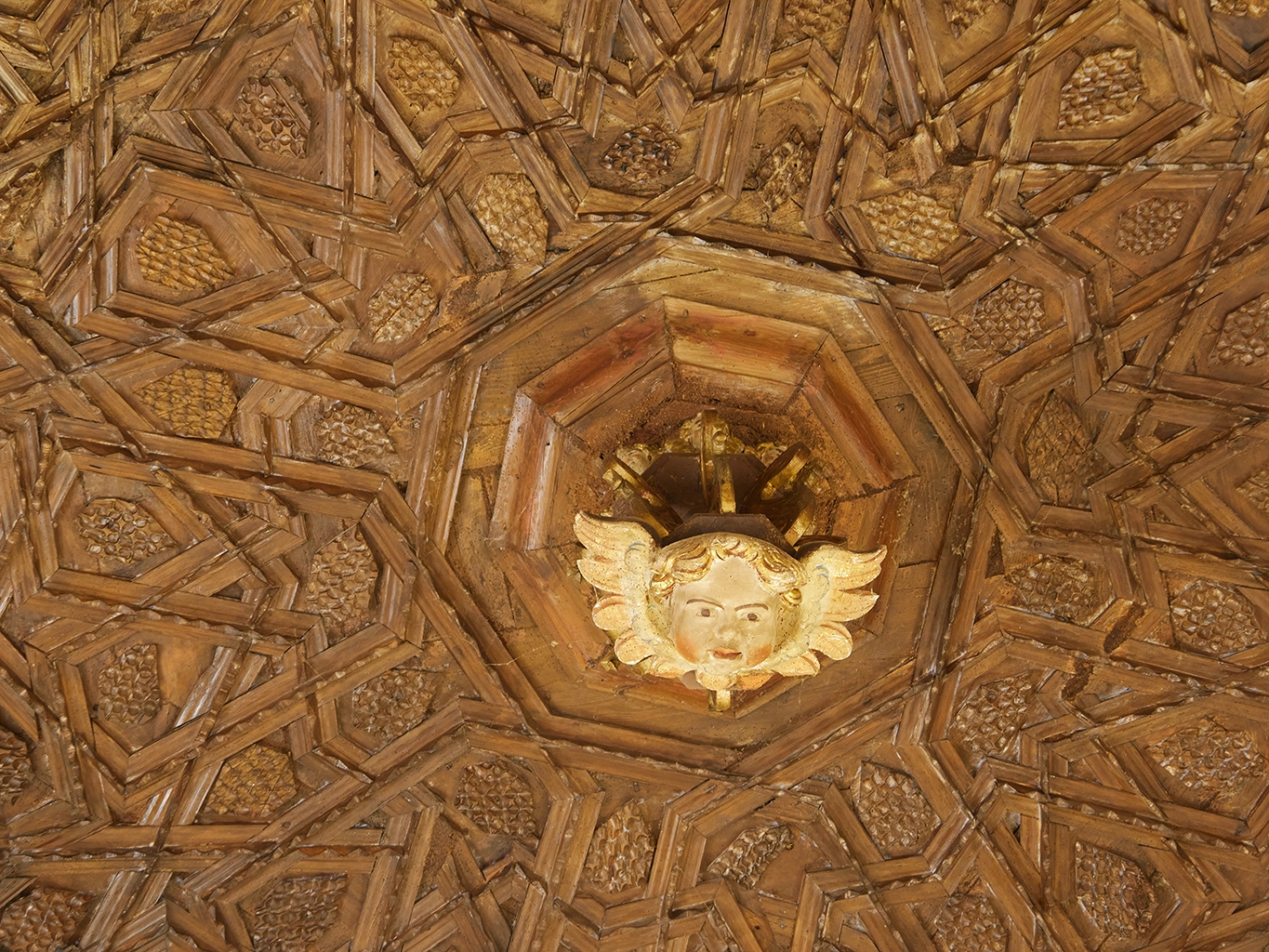
The apse has a Mudejar coffered ceiling decorated in the 16th-century style. It had been painted blue, which made it inconspicuous, but it was restored in the early 21st century and now shines in full splendor. It features the classic motif of pinecones framed in stars, with a sculpture of an angel’s face, still in color, hanging from the central vault piece. This coffered ceiling rests on four pendentives, which were once decorated with canvas paintings of the four evangelists, now stored to prevent deterioration.
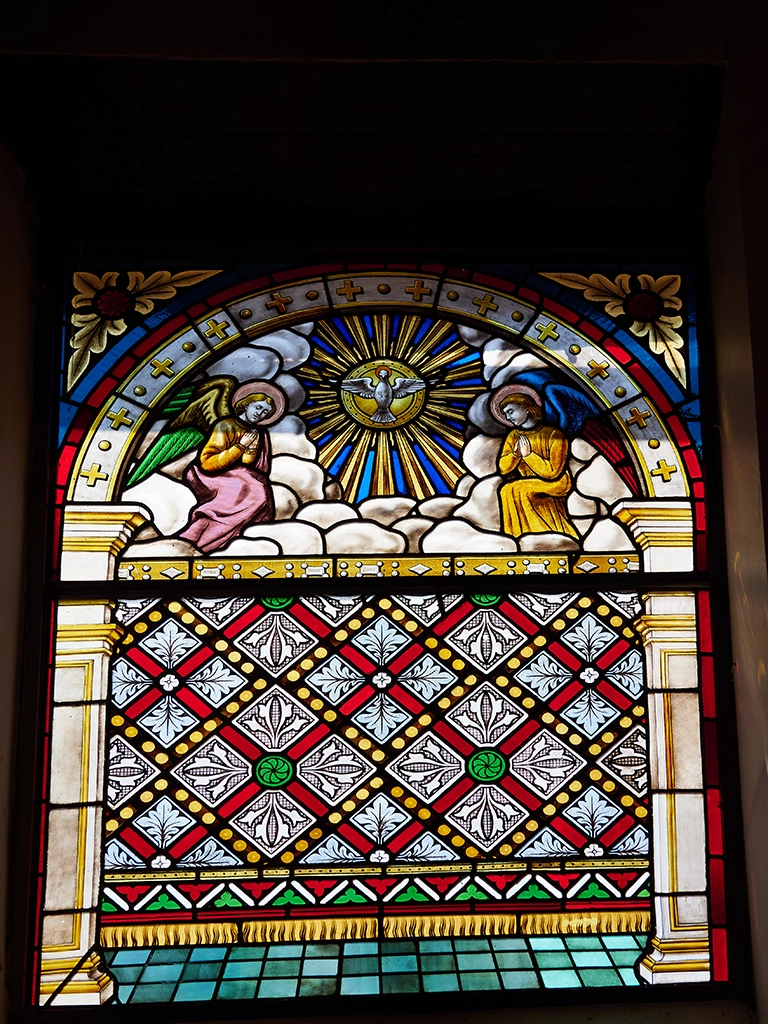
A door in the apse leads to the sacristy, and a window allows natural light to enter. The stained glass window is the result of a restoration in the early 21st century of an earlier piece that had been stored in the church.
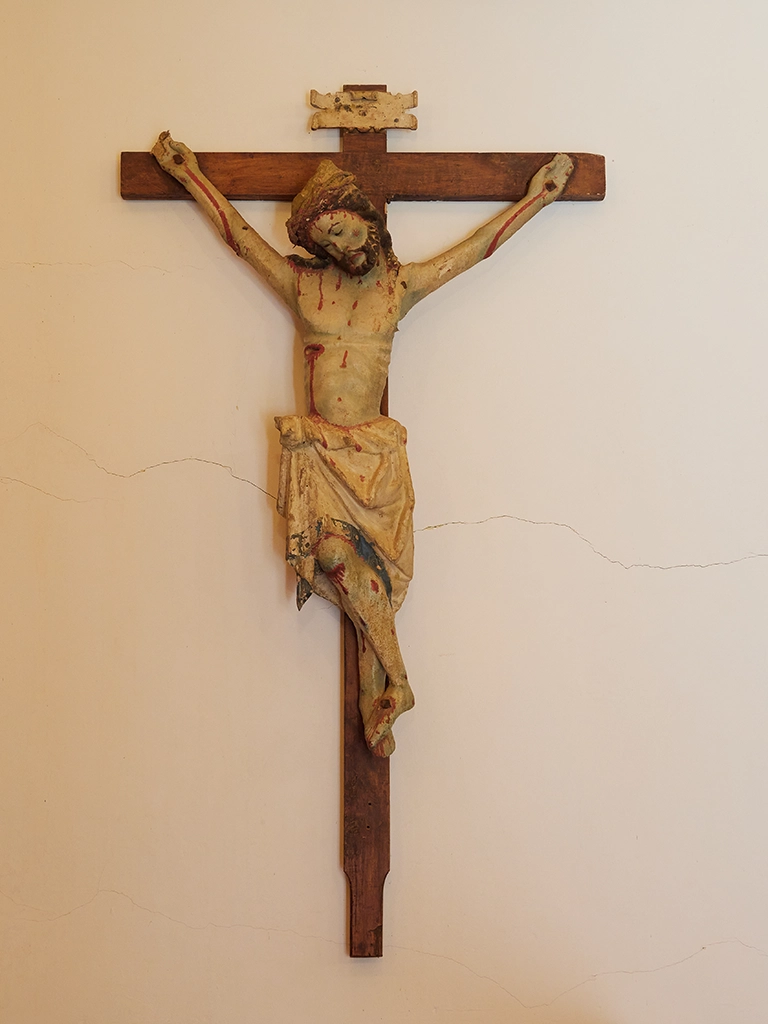
In the central nave, on the wall opposite the entrance, there is a freestanding sculpture of a Crucified Christ in Gothic style—a fine 14th-century Gothic carving with typical features of this kind: soft, non-muscular arms and body; head gently tilted to the right side, with a serene expression and no signs of suffering; an abundant loincloth with coarse folds covering to the knees; and disproportionate legs with feet joined together to be pierced by a single nail.
In the past, the church also housed the Virgin of Carbajosa, a 12th-century Romanesque sculpture 66 cm tall, now displayed at the León Cathedral Museum, to where it was moved for its value in the 1970s. It is one of the so-called “dumb Virgins.” The Virgin is a true Throne of Wisdom, while the child, a small king, holds a book and appears majestic with imperial bearing.
The church also has a baptismal font to which an inner basin has been awkwardly added to allow baptisms without immersion, though it does not detract from the appreciation of its original craftsmanship.
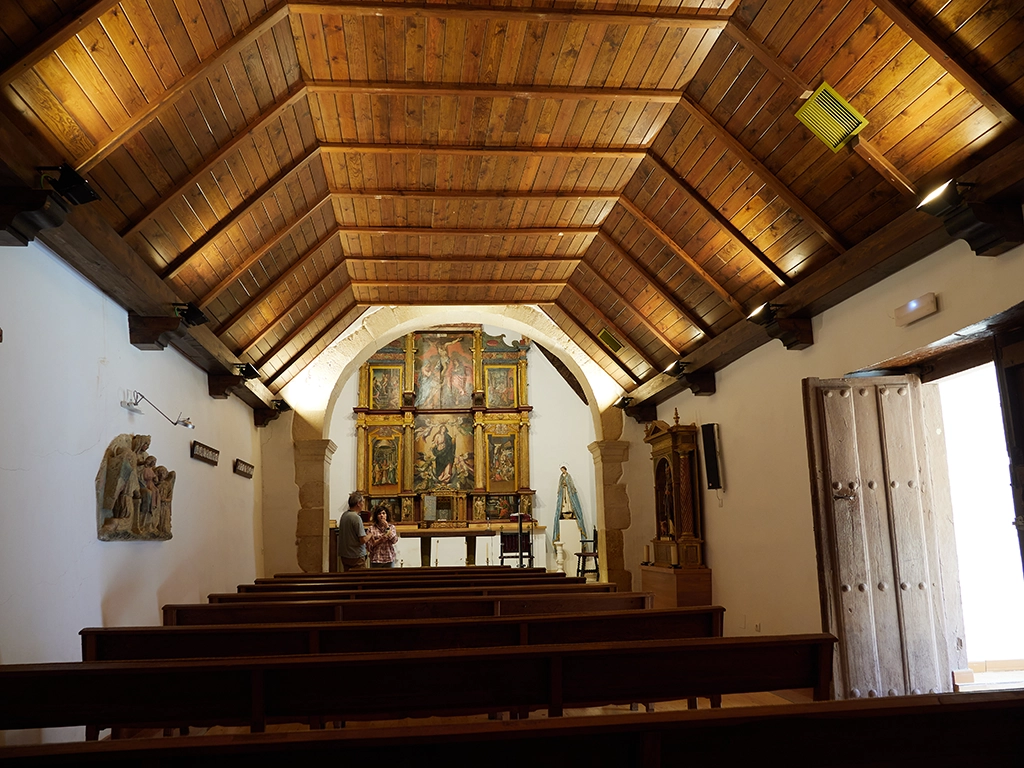
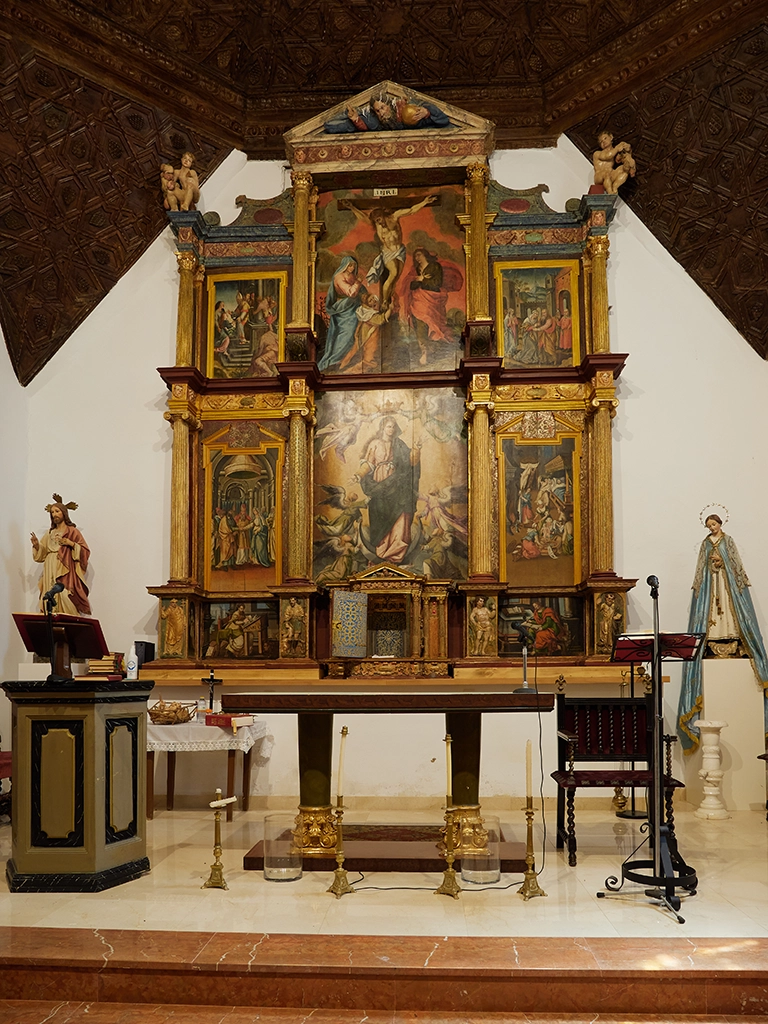
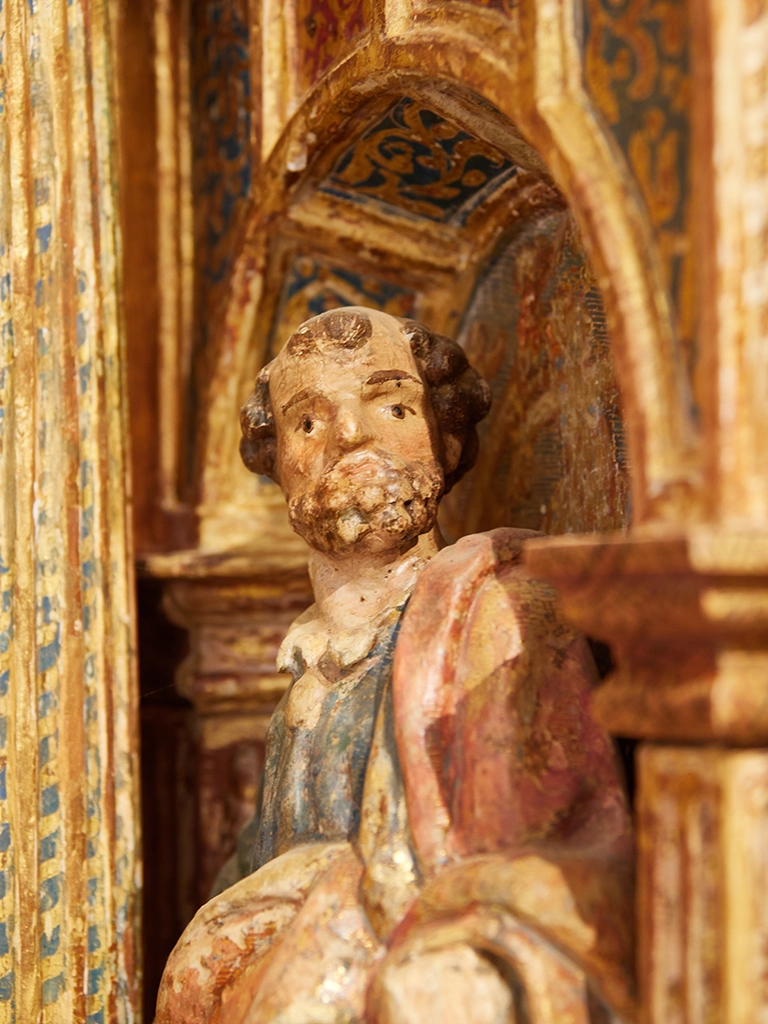
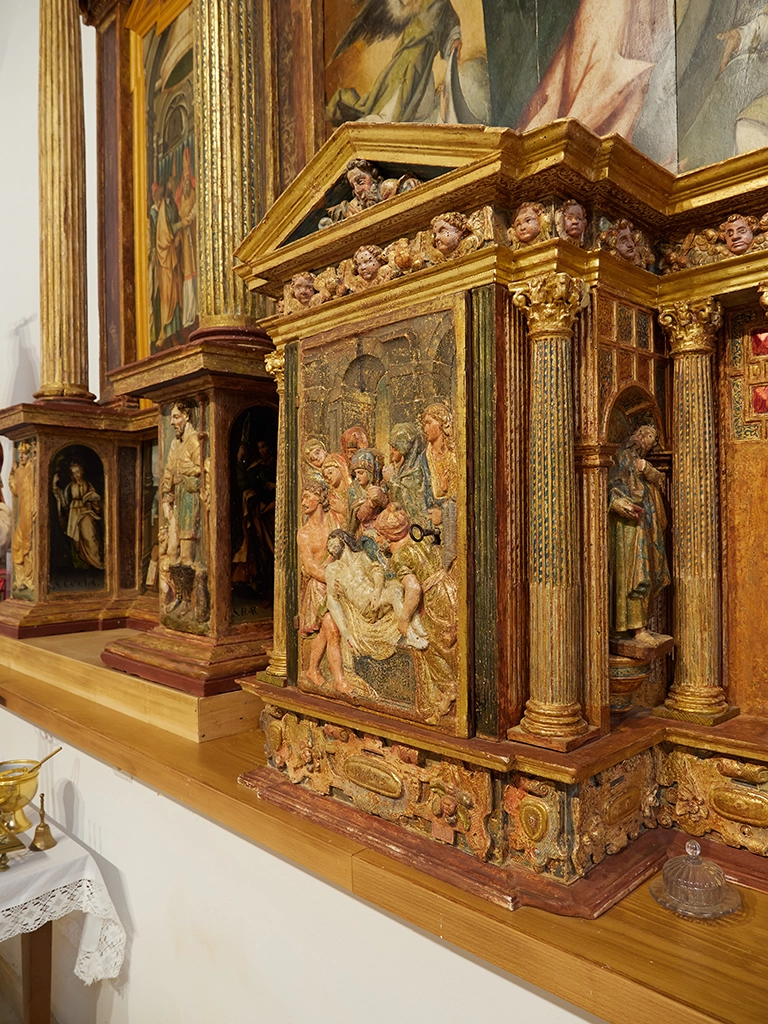
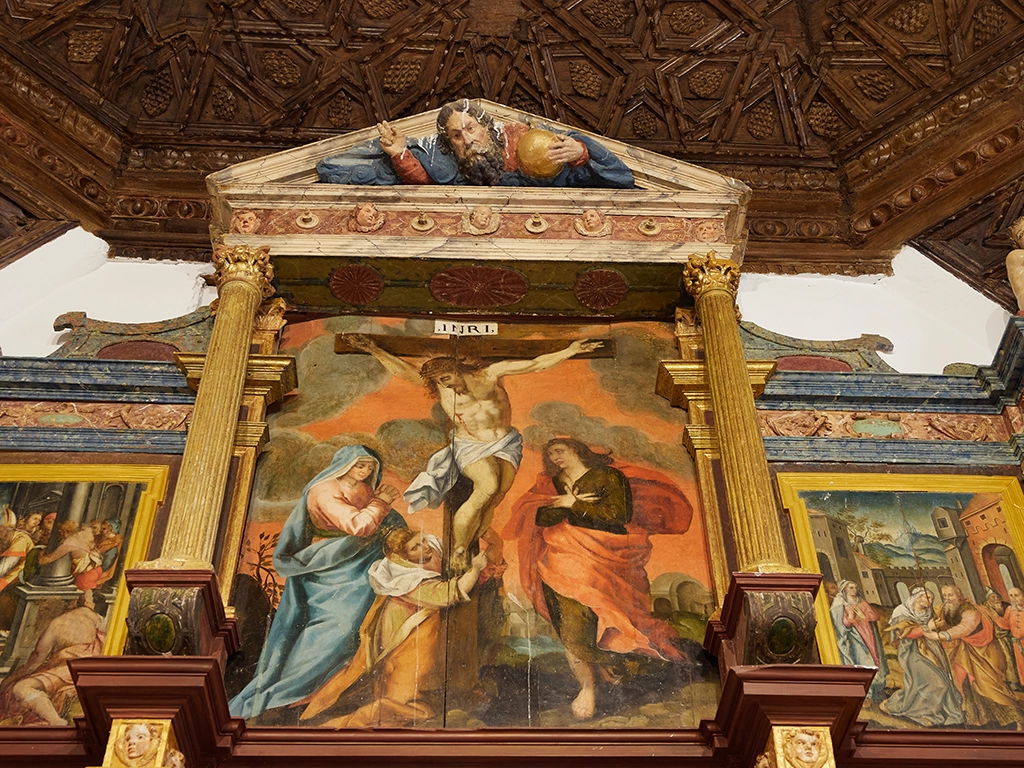
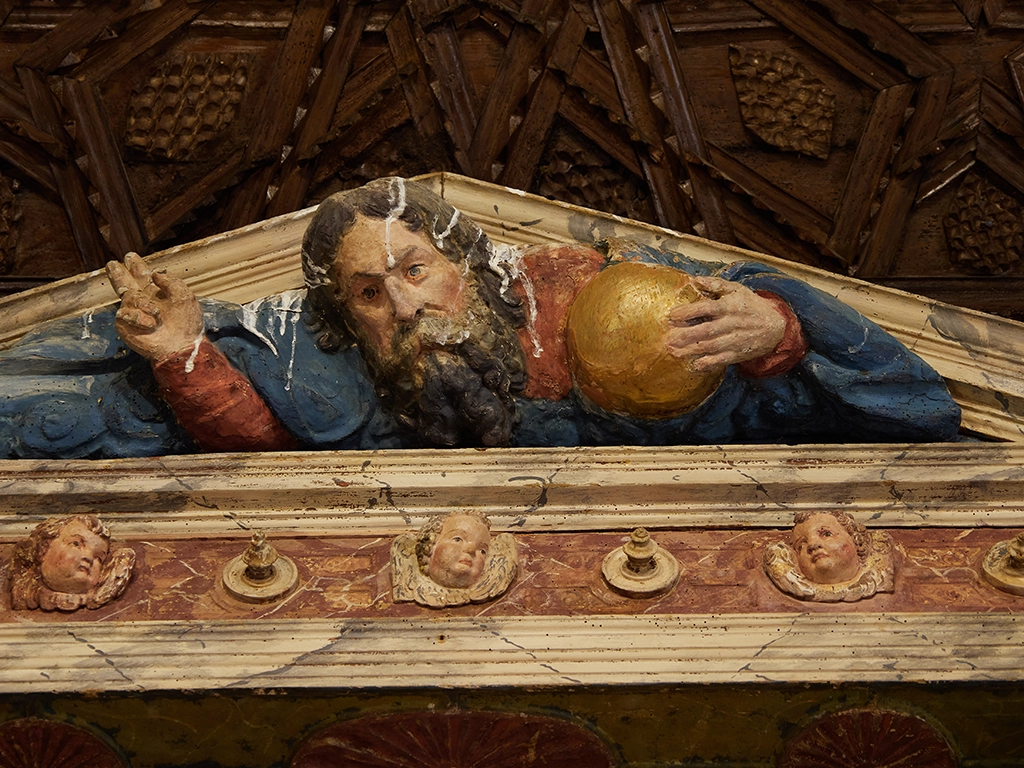
The altarpiece, with three vertical panels and two horizontal tiers, is topped by a pediment of God the Father and frames paintings of scenes from Christ’s life, Crucifixion, and Ascension.
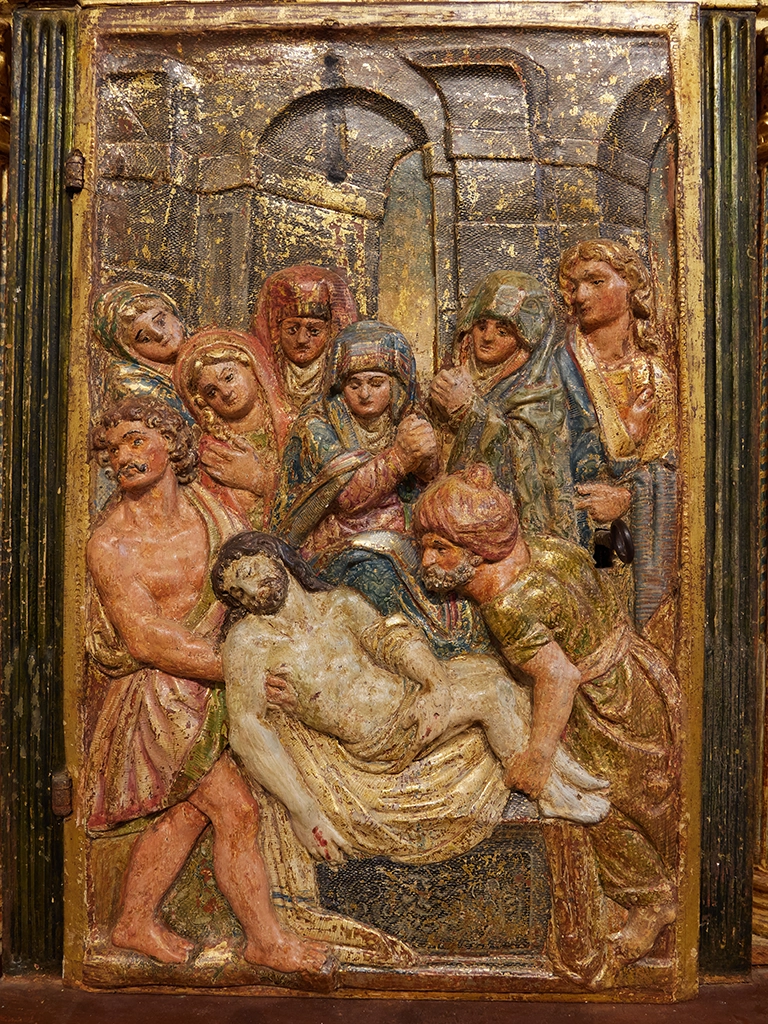
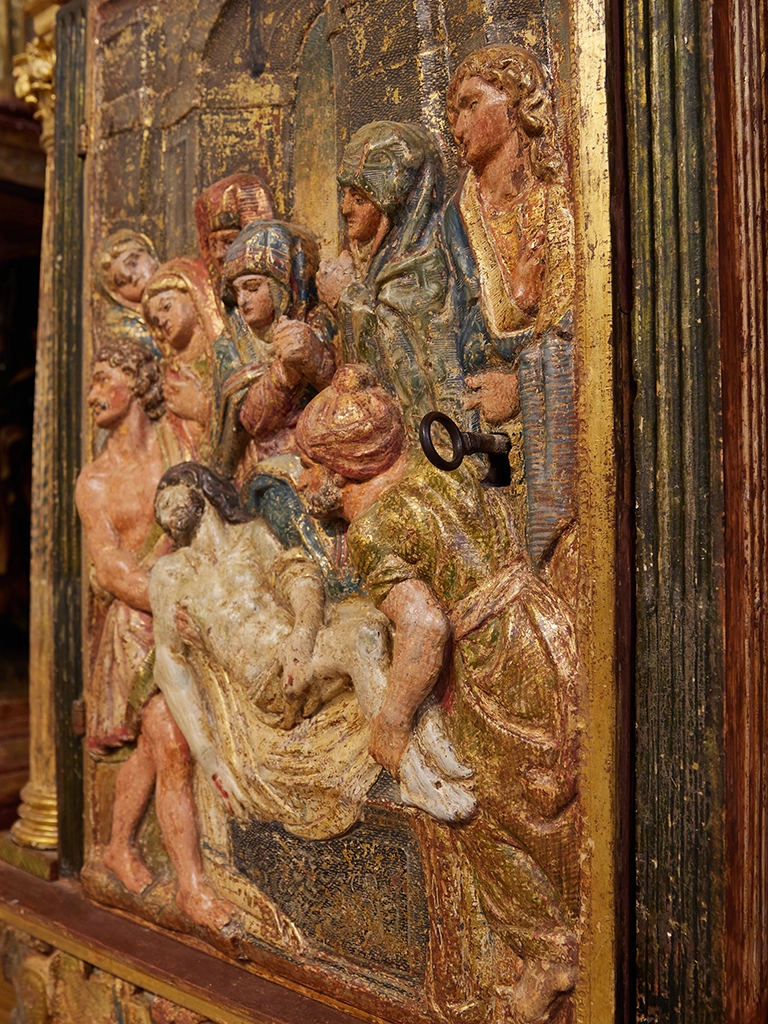
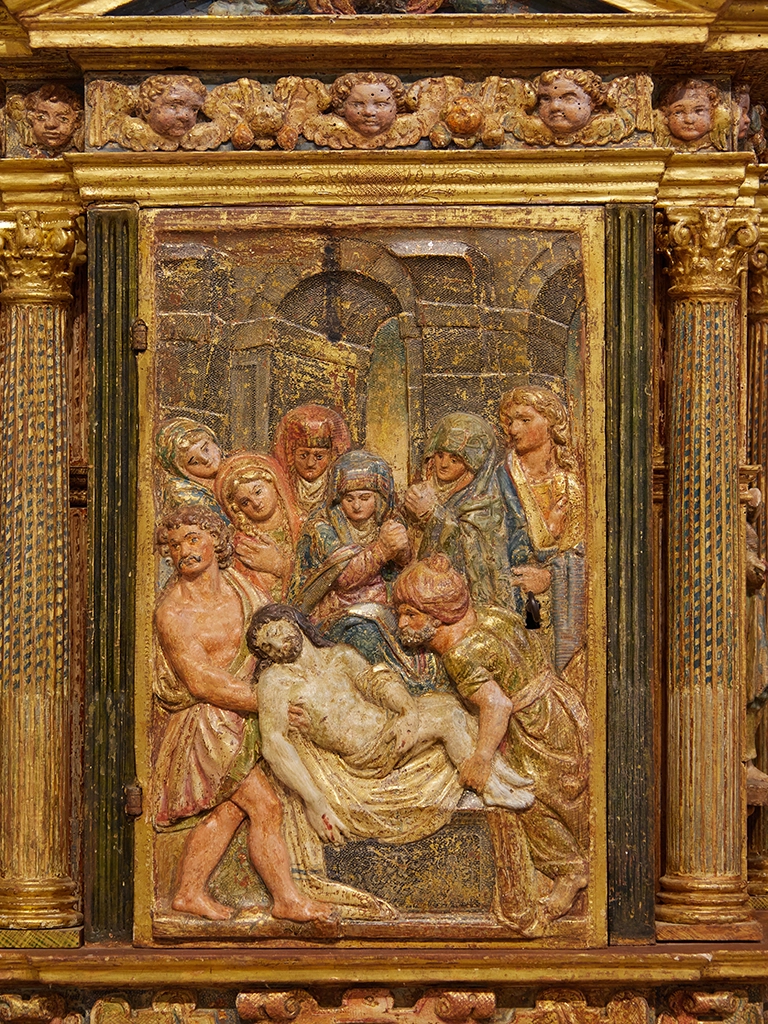
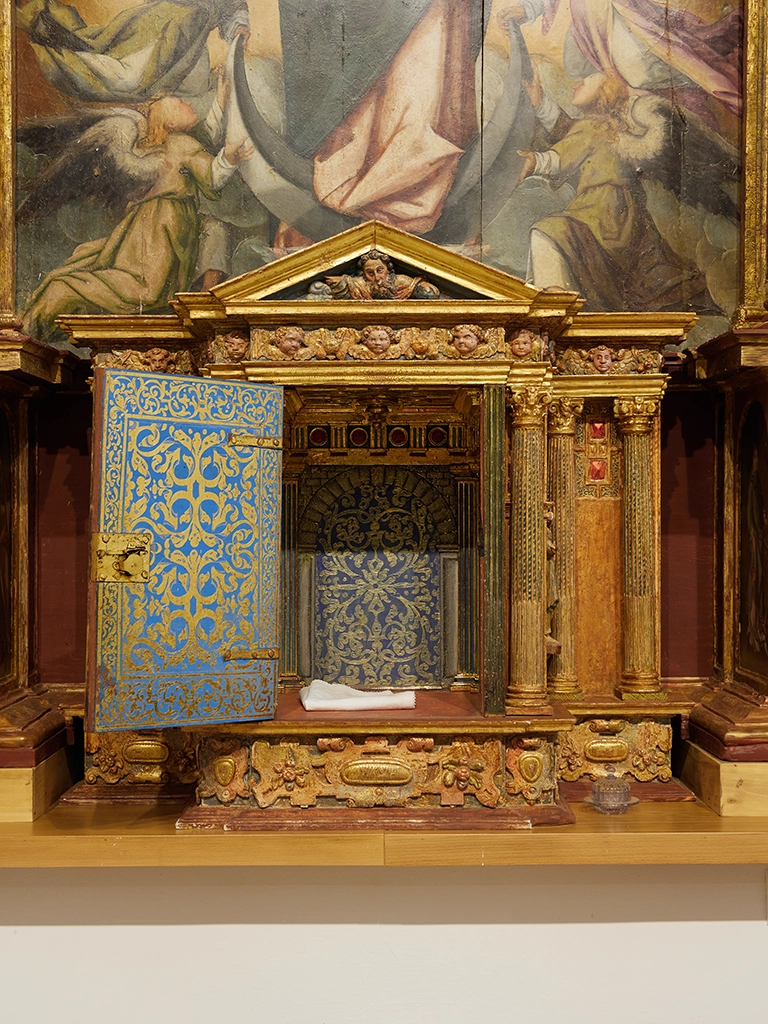
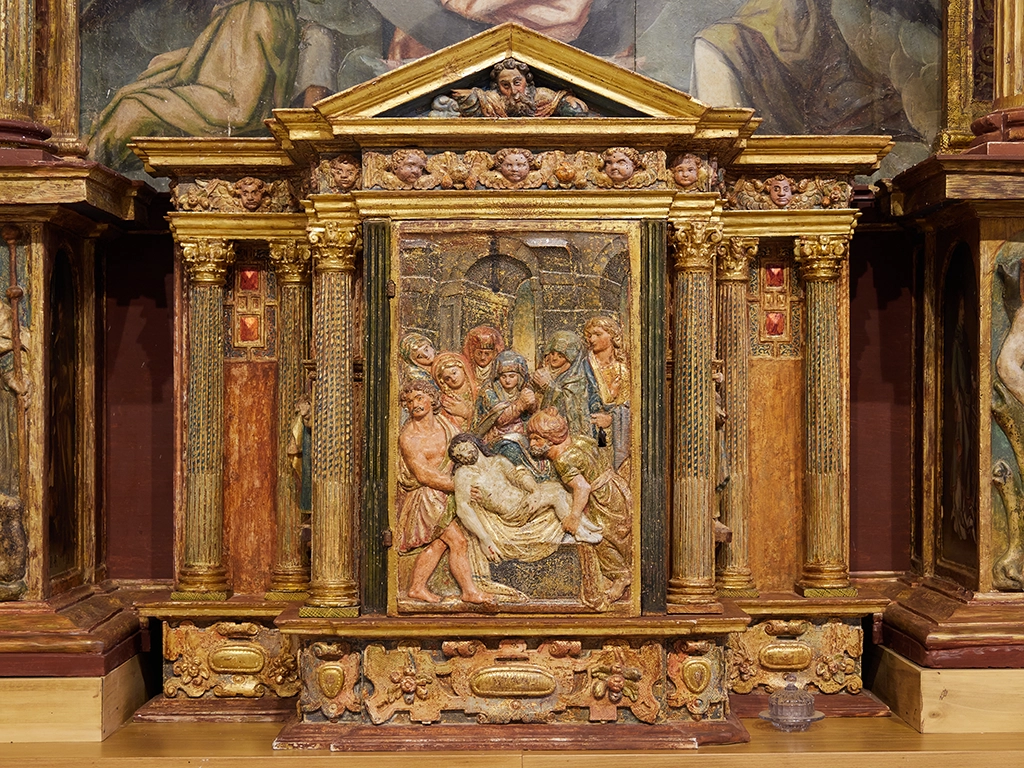
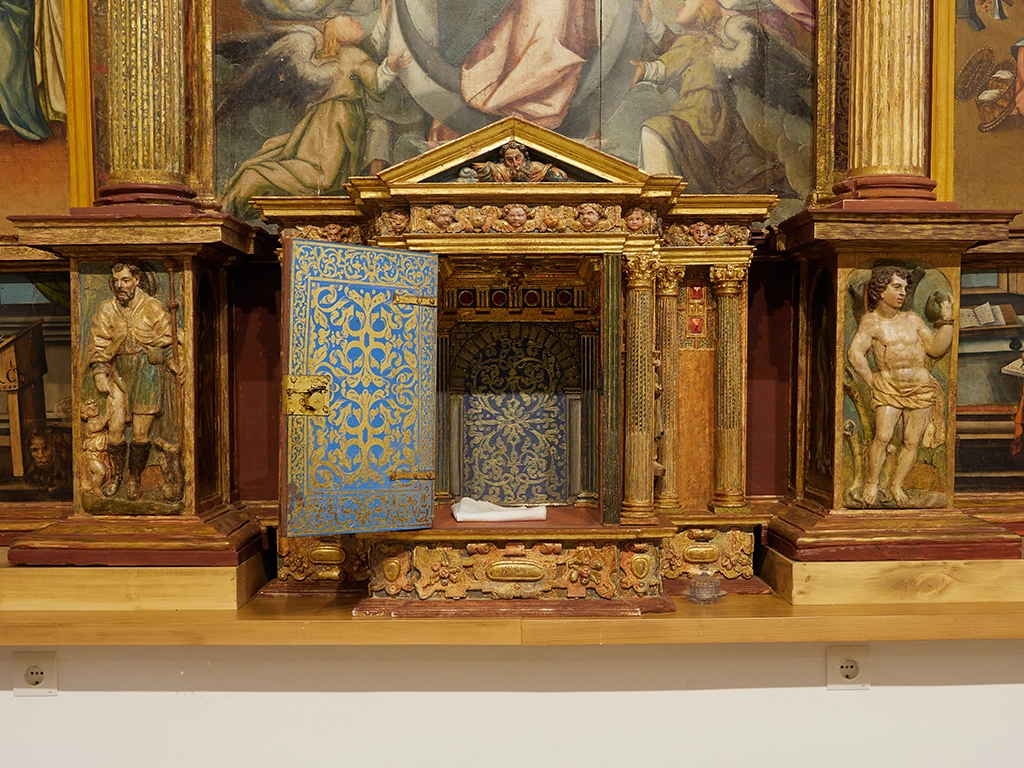
The tabernacle is Renaissance and the work of one of the masters who worked in León Cathedral. It features a relief of the Holy Burial carved on its door, with the characters depicted in violent, distorted, mannerist attitudes.
Both the tabernacle and the altarpiece were restored in 2010 (first the tabernacle, whose restoration suggested the hidden value of the altarpiece and led to its restoration) in a joint effort by the Diocese Restoration Workshop and CajaEspaña, culminating in an exhibition at the Botines Building in León before being reinstalled in the church.
This restoration confirmed that the parish church’s altarpiece in Carbajosa is a 16th-century work. The diocesan heritage delegate of León, Máximo Gómez Rascón, highlighted its high artistic value in statements to Europa Press (2010). The panels reflect late 16th-century styles and were created by sculptors Diego de Solís and Nicolás Pizarro, and painter Gregorio de Herreras.
In the 19th century, a restoration had overpainted the panels with poor-quality work, obscuring their significance. Current experts believe the pictorial panels are preserved intact, though the structure suffered losses, likely due to the poor skills of earlier restorers. The architectural framework is conceived as a jewel box in which the panels are set, adorned with gold and silver leaf, and mimicking the tabernacle’s sculptural relief structure.
The restorers believe the models used were two works by Juan de Juanes and Giacopo Palma, slightly modified to fit the theme.
The altarpiece features a Crucifixion at the top in the second tier, two large panels including an Ascension, and four smaller panels depicting scenes from the Virgin’s life. The predella shows saints such as Saint Barbara and Saint Andrew.
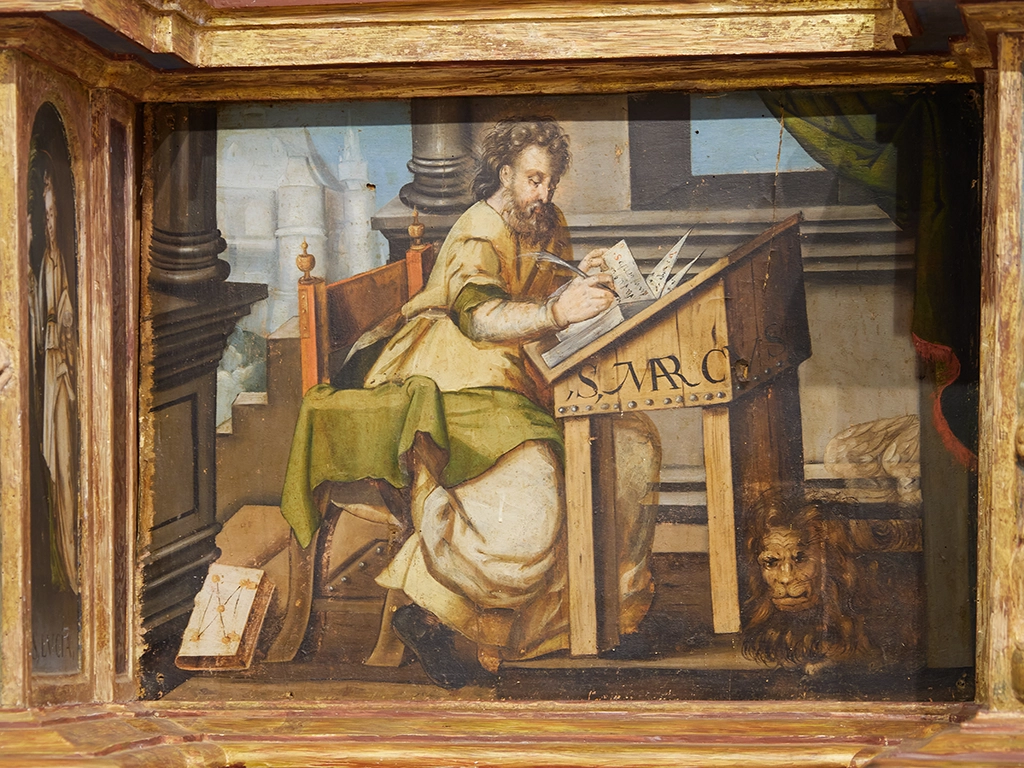
The altarpiece follows the tabernacle’s design, replicating some structural elements. The entire lower bench, where the tabernacle is located, contains four oil paintings—each dedicated to one of the four evangelists—also from the 16th century and by one of the same painters who worked in the Cathedral.
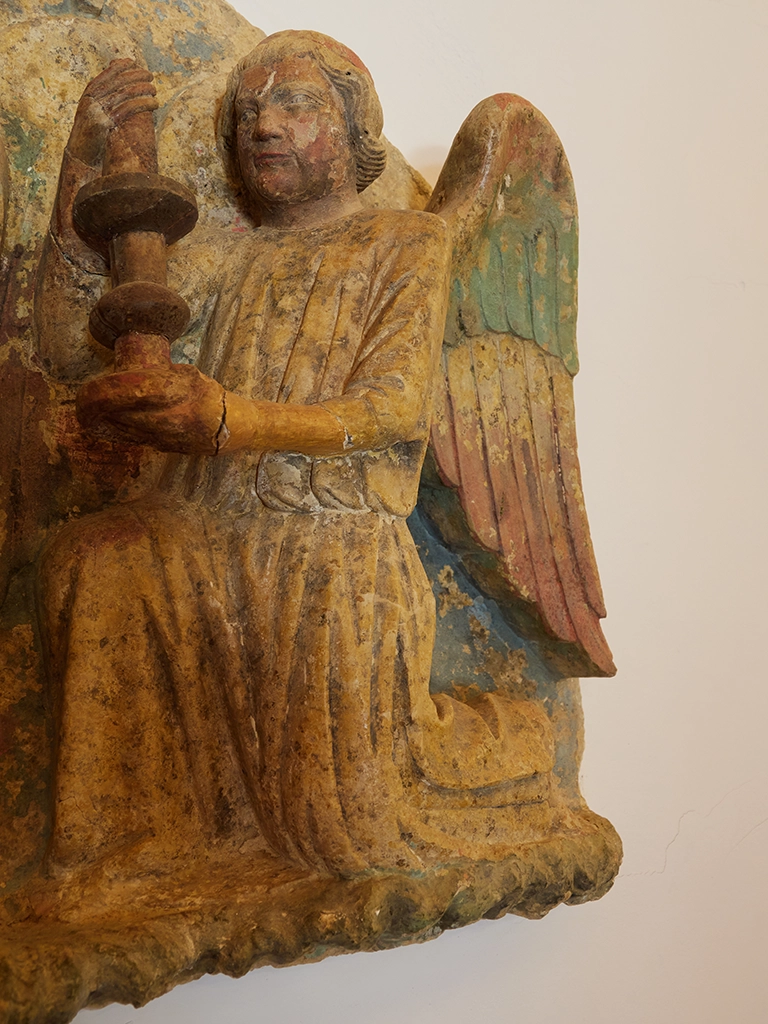
Inside the church is also a Gothic relief from the late 13th or early 14th century, in polychrome stone, measuring 71 cm. Tradition says it came from a tympanum of the now-lost monastery of San Pedro de Eslonza. It was found in the destroyed hermitage of the Virgin of Lario (“del’ ario,” meaning a mound with a circle of stones) or the Immaculate Virgin. In 1977, it received an award from the Directorate General of Artistic and Cultural Heritage as the best artistic object found by a group known as “Misión Rescate.”
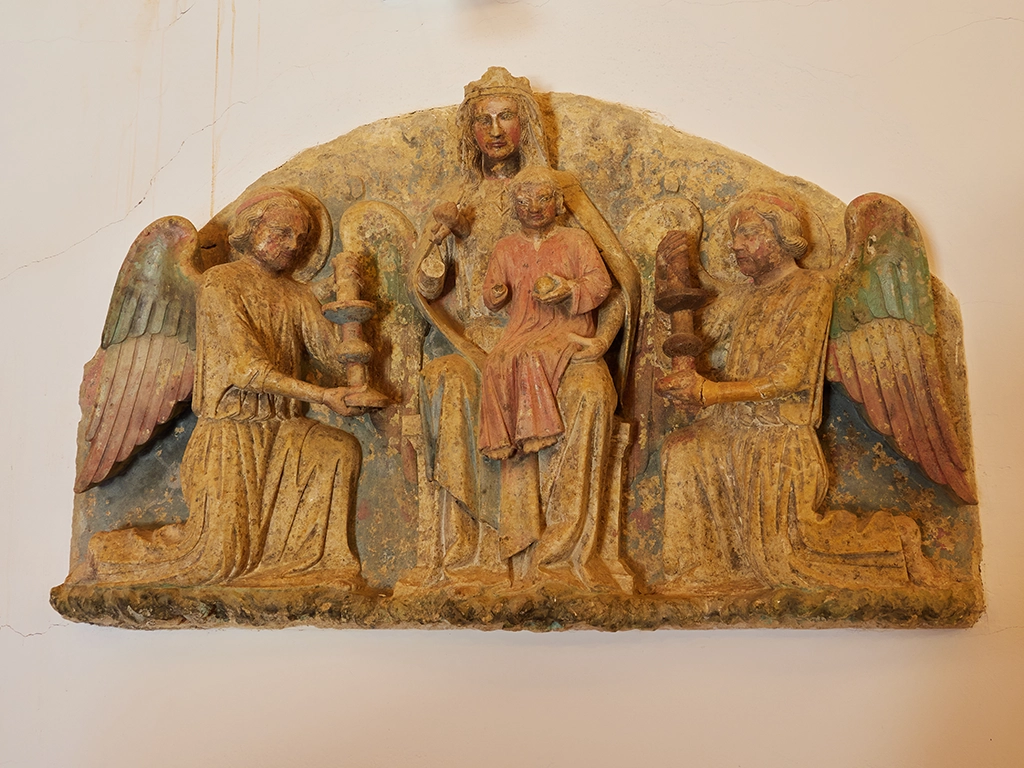
According to experts Drs. Manuel Valdés, Victoria Herráez, and Concepción Cosmen (2001, pp. 152-153), the tympanum currently inside Carbajosa’s church is Gothic, 122 cm wide by 70 cm high, and comes from a hermitage outside the village on a hill called “Del Ario.” It is a high relief depicting the Virgin with the Child between two candle-bearing angels. The central figure sits on a backless throne, with only two smooth front supports visible, and the Child rests on her left knee, holding a pomander in one hand, while the other is missing.
The angels kneel with one knee on the ground and hold candles with both hands—a Romanesque tradition often seen in Gothic depictions. The bottom edge of the piece is wavy and seems to resemble clouds supporting the scene.
Again, this is a scene repeated in the funerary sculpture of León Cathedral, on the tombs of Juan Martínez Díaz, Archdeacon of Saldaña, and Miguel Domínguez, Archdeacon of Triacastella, where in a lower register, cherubs present the soul of the deceased to the Virgin Mary. The symbolism refers to the moment of individual judgment with Mary as intercessor—an idea well-developed in the Gothic period.
The Carbajosa tympanum is a simplified version, omitting the second part of the act. Yet formally, it is a strange piece, not assignable to the well-known artistic circles of the province, which would normally be linked to León’s main church. The angels’ draped tunics, the ribbons in their hair, and the peculiar facial features make it difficult to attribute the work to a known master. Its formal and iconographic traits suggest a date at least as late as the end of the cited century.
The tympanums of Carbajosa, with the Virgin between candle-bearing angels, and of La Aldea del Puente, with Christ between incense-bearing angels, are other examples of the dispersal of cathedral models.
In a specific study of this tympanum, researchers Drs. Herráez and Cosmen (1979, pp. 52-58) describe:
In high relief, the Virgin is shown with the Child between two candle-bearing angels. The central figure sits on a backless throne, with only the two smooth front supports visible. The Child, on her left knee, holds a pomander in one hand, the other now broken. Jesus wears a long, pleated tunic that reveals part of his feet; his head connects to the torso with a short neck and his face, framed by short, wavy hair, features large, almond-shaped eyes and a wide, straight nose.
Mary wears a flowing tunic gathered at the waist, fastened below the neck with a rhomboidal brooch with curved sides. Her mantle wraps her body, covering her bent right arm, which holds a flower. Her head is veiled and crowned; her hair falls in waves over her shoulders. Most striking are her large almond-shaped eyes and the expressionless face.
The angels kneel with one leg on the ground, holding candles with both hands. Their tunics are cinched at the waist, creating regular folds. Their heads are shown in profile, with wavy hair tied with a ribbon, and their faces echo the previously described features. Smooth halos and outspread wings complete the depiction. The lower edge is wavy and appears to mimic clouds supporting the scene.
Again, we find a scene that recurs in the funerary sculpture of León Cathedral, in the tombs of Juan Martínez Díaz, Archdeacon of Saldaña, and Miguel Domínguez, Archdeacon of Triacastella.
The name comes from a toponym, as it was found in the now-disappeared hermitage of Ario. Although it was discovered in the hermitage, it is believed to have originated from the monastery of Eslonza, since hermitages generally lack the means or wealth to commission carved stone works. It also does not belong to the church’s endowment, as the church was founded around the 16th century, therefore later than the date of the relief.
It falls within the transitional Gothic style between the 13th and 14th centuries. It is a symmetrical relief featuring two angels in an attitude of adoration. It is characteristic, in fully round sculptures of the Virgin, that there is a resemblance between the Mother and the Child. But in this relief, all the figures share the same anatomical features, carved by the same hand, with full, round faces and almond-shaped, archaizing eyes — already evolving beyond round, frontal eyes. There is also frontality in the angels’ wings.
The artist aimed for naturalism in the folds of the clothing and in ornamental details, such as the Virgin’s fibula and the angels’ diadems, as well as in the individualized hair, which, along with the crown that only she wears, gives her the presence of the Queen of Heaven and Throne of Wisdom. However, the forms are still somewhat rigid, overly angular and striated.
Noteworthy is the preservation of its polychromy, which, although incomplete, makes this piece highly valued as a document, reinforcing its significant artistic value. It indicates that at the time of its creation, this was the custom; the polychromy shows the work was conceived for visual and catechetical impact, aiding in the clarity of the message represented.
It is necessary to contextualize this tympanum as part of a larger ensemble that undoubtedly existed, almost certainly as the upper decorative element of a doorway, whose archivolts — also polychromed and perhaps richly populated with images — framed the image of Saint Mary with the Child, ending in a pointed arch. Around this tympanum, scenes from the Old and New Testaments would be depicted, culminating at the top with Mary as the beginning of the divine plan. All of this would have been set into a dressed stone façade, pointing to a significant building, reinforcing its likely origin in the monastery of Eslonza.

Discover Sobrarriba through an unforgettable journey through its heritage, culture and landscapes. The Sobrarriba Cultural Route offers guided tours and detailed explanations at various points of interest, combining history, architecture, traditions and nature in a unique experience.
Each route is designed to suit different types of travellers: from walkers and cyclists to those who prefer horse riding or even hot air ballooning. Join us on a journey through time and delve into the secrets of a land that has witnessed centuries of history.

Discover Sobrarriba through an unforgettable journey through its heritage, culture and landscapes. The Sobrarriba Cultural Route offers guided tours and detailed explanations at various points of interest, combining history, architecture, traditions and nature in a unique experience.
Each route is designed to suit different types of travellers: from walkers and cyclists to those who prefer horse riding or even hot air ballooning. Join us on a journey through time and delve into the secrets of a land that has witnessed centuries of history.
Alaiz Prieto, Atilano, La Sobarriba: geografía, historia y arte de una comarca leonesa, Vigo, 2007.
Barreñada García, Antonio, La hermandad de la Sobarriba: Regla, Ordenanzas y Constituciones para la Procesión a Nuestra Señora del Camino el día de San Isidoro, acompañada de noticias y apuntes históricos sobre el Voto a sus Ayuntamientos, León, [el autor], 2005.
Cosmen, María Concepción, y María Victoria Herráez, “Los tímpanos góticos de La Aldea del Puente y Carbajosa”, artículo en la revista de investigación Tierras de León, nº 76, 1990, pp. 51-58.
Domínguez Sánchez, Santiago, Informe sobre algunas piezas muebles de la iglesia parroquial de Carbajosa de Ia Sobarriba del Departamento de Patrimonio Artístico y documental de la Universidad de León, 26 de enero de 2023.
Europa Press Castilla y León, “Botines (León) muestra el retablo de la iglesia de Carbajosa restaurado, del siglo XVI, un “auténtico descubrimiento”, fecha de publicación lunes, 20 diciembre 2010 14:59 en Newsletter, @epcastillayleon. Artículo periodístico, disponible online: https://www.europapress.es/castilla-y-leon/noticia-botines-leon-muestra-retablo-iglesia-carbajosa-restaurado-siglo-xvi-autentico-descubrimiento-20101220135931.html
García Luna, Óscar, Memoria para la solicitud subvención del Instituto Leonés de Cultura para la REHABILITACIÓN DE LA CUBIERTA DE NAVE DE LA IGLESIA DE LA ASUNCIÓN DE NUESTRA SEÑORA DE CARBAJOSA en el Plan Iglesia Abierta 2023/24.
González Díaz, Manuel, La Sobarriba: Estudio socio-ambiental, Universidad de León, Tesis de licenciatura dirigida por Vicente Martínez Encinas, 1985.
Herráez, María Victoria, y María Concepción Cosmen, “La escultura gótica en León”, capítulo incluido en el libro colectivo la Historia del Arte en León, León, 1990, pp. 137-167, especialmente en pp.157 y 165.
Valdés, Manuel, Victoria Herráez y Concepción Cosmen, Arte gótico en la provincia de León, León, Universidad de León, 2001.