
Baptismal Font of Villacil
Notable historical and heritage significance
Baptismal Font of Villacil
Notable historical and heritage significance
Baptismal Font of Villacil
Notable historical and heritage significance
In Late Antique and Early Medieval Hispania (4th–7th centuries), baptism was carried out predominantly by full immersion, generally administered to adults. For this purpose, independent baptisteries were built, separated from the main church, with circular, octagonal, or square plans, large pools excavated into the ground, and water drainage systems. These spaces, charged with strong symbolic meaning, were associated with the idea of baptism as death and resurrection, descent and rebirth, and constituted true ritual buildings.

From the 8th to the 11th centuries, coinciding with the progressive and complete Christianization of the population and the generalization of infant baptism, the rite of immersion gradually lost prominence. This shift brought about a decisive transformation in baptismal architecture: large baptisteries ceased to be built, and many of their structures were abandoned, reused, or altered. In their place, smaller baptismal fonts began to appear, adapted to baptism by infusion or aspersion.
From the 11th century onward, and especially during the 12th and 13th centuries, the Romanesque baptismal font as we know it today became established in Spain: massive stone vessels, generally circular, raised on a pedestal and located within the church space. These fonts were decorated with a rich symbolic repertoire—rope mouldings, arcades, vegetal motifs, or figurative scenes—and were fully integrated into the architecture of the church, typically near the entrance, emphasizing baptism as the gateway to the Christian community.
In many rural areas, particularly in the northern Iberian Peninsula, this process was not abrupt but gradual. In numerous cases, former immersion baptisteries were reused as the base for new Romanesque fonts, preserving subterranean structures, stone rings, or hydraulic systems that today allow the liturgical evolution of the building to be reconstructed. These reutilizations make certain fonts and bases exceptional testimonies of ritual continuity spanning several centuries.
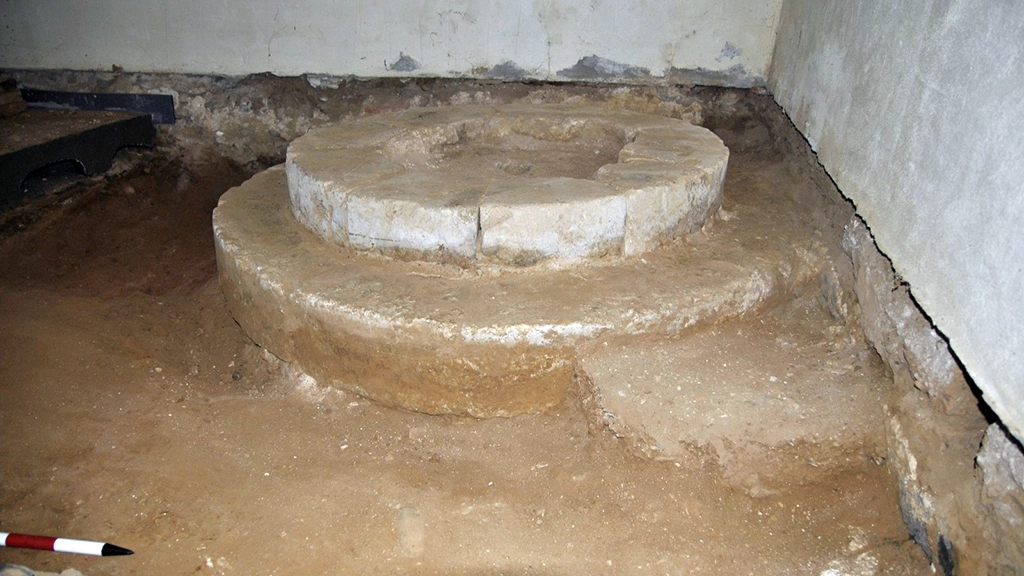
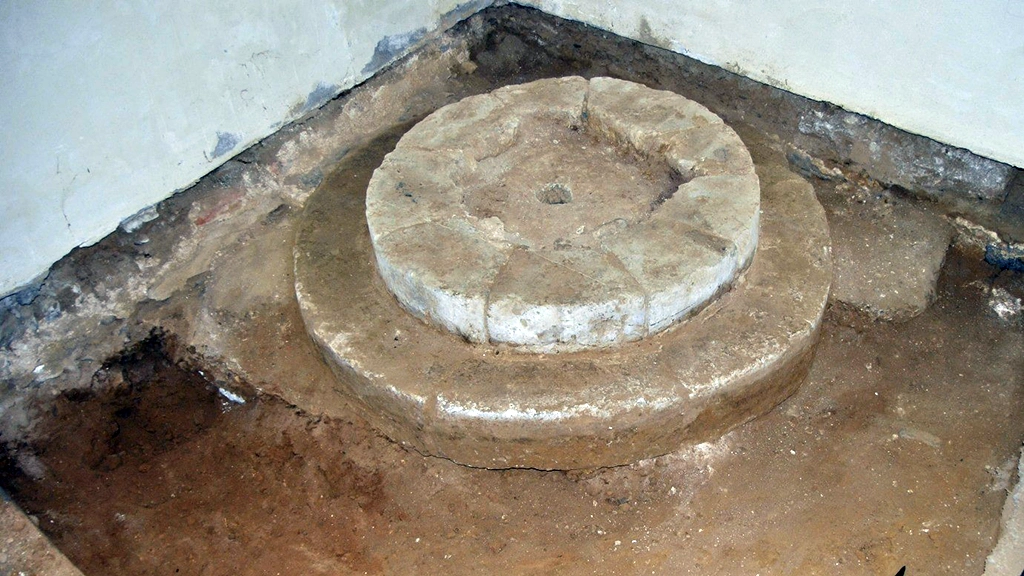
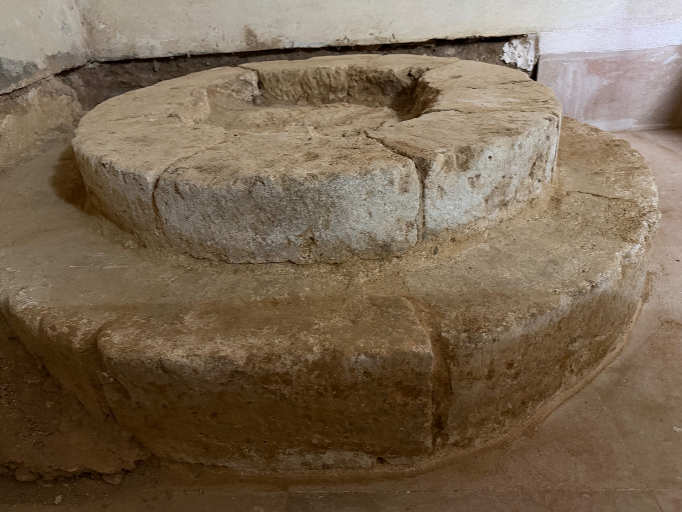
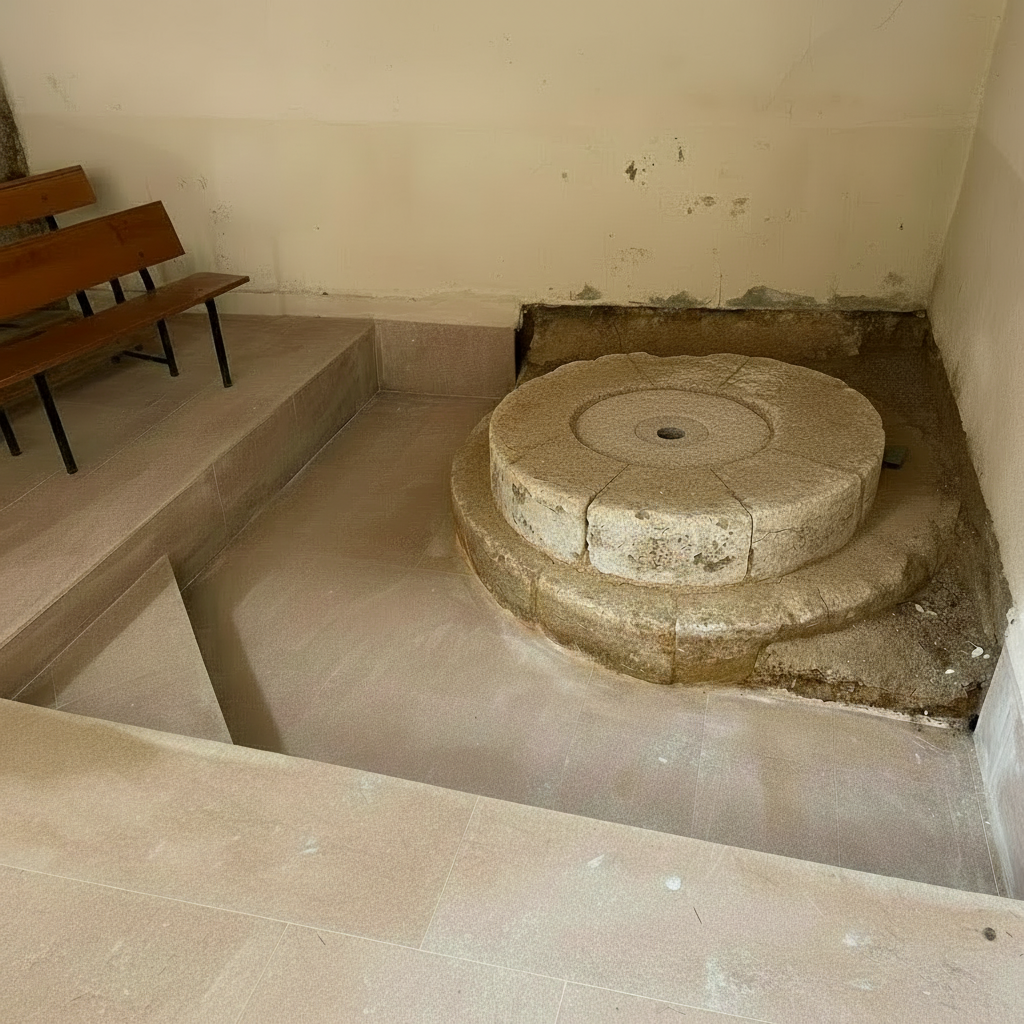
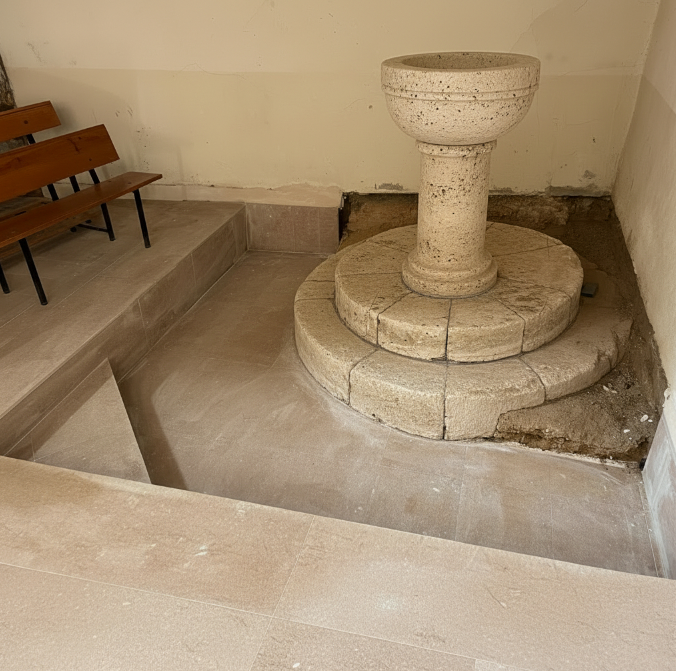
The structure discovered beneath the pavement of the church of Villacil corresponds to a liturgical installation of notable antiquity and exceptional interest for the study of the Christian origins of the building and the evolution of the baptismal rite in the rural context of León. It consists of a stone construction with a circular or oval plan, made of limestone, composed of two concentric rings and a central opening that connects to a lower cavity carved directly into the bedrock.
The structure has an approximate external diameter of two metres and a central ring of about eighty centimetres, with a visible depth of nearly seventy centimetres, although its original depth must have been greater, as indicated by its partial burial. The presence of a water drainage opening confirms its functional conception related to the handling of water, an indispensable element in baptismal rituals, whose destination was always consecrated ground.
The overall morphology of the ensemble—concentric plan, deep chamber, drainage system, and intermediate platform—fully corresponds to immersion baptismal fonts characteristic of the Early Middle Ages, used between the 6th and 10th centuries, when baptism was performed by partial or total immersion, usually of adults. This type of structure predates the introduction of elevated Romanesque fonts and implies the existence of a stable and organized Christian community at a very early stage.
Analysis of the interior confirms the technical complexity and deliberate construction of the ensemble, ruling out functional interpretations unrelated to the liturgical sphere.
In the upper part of the interior, a crown of rough masonry can be observed, formed by irregular, uncut stones of varying sizes and natural shapes. These elements are set with reddish clayey earth, without the use of lime mortar, indicating a filling system intended to level and stabilize the structure.
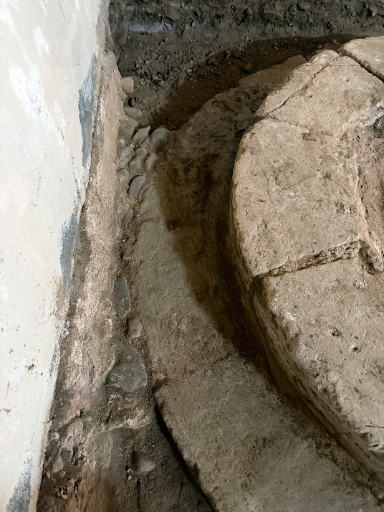
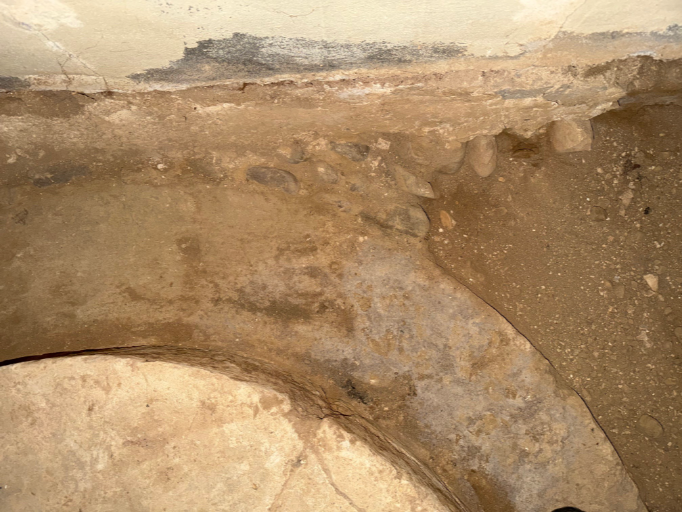
This type of masonry does not respond to decorative criteria or to a monumental execution intended to be visible, but rather to a purely structural function: it serves as a transition between the outer body of the font and the inner chamber, ensuring proper load distribution. Its presence rules out the possibility of a Roman or Visigothic decorative basin and clearly points to a functional construction solution typical of early medieval contexts.
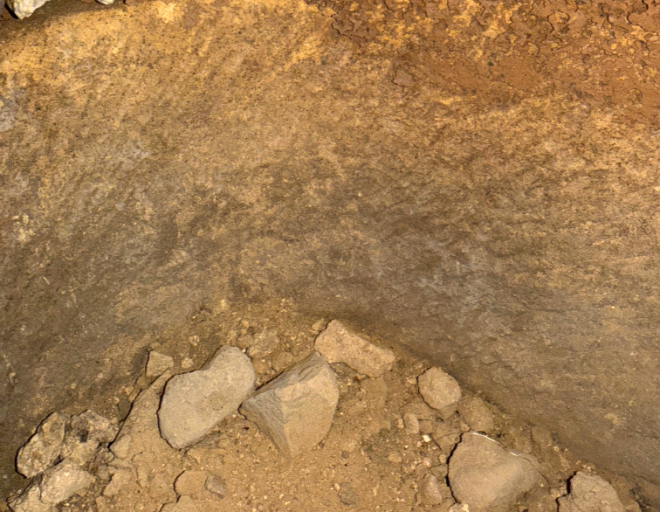
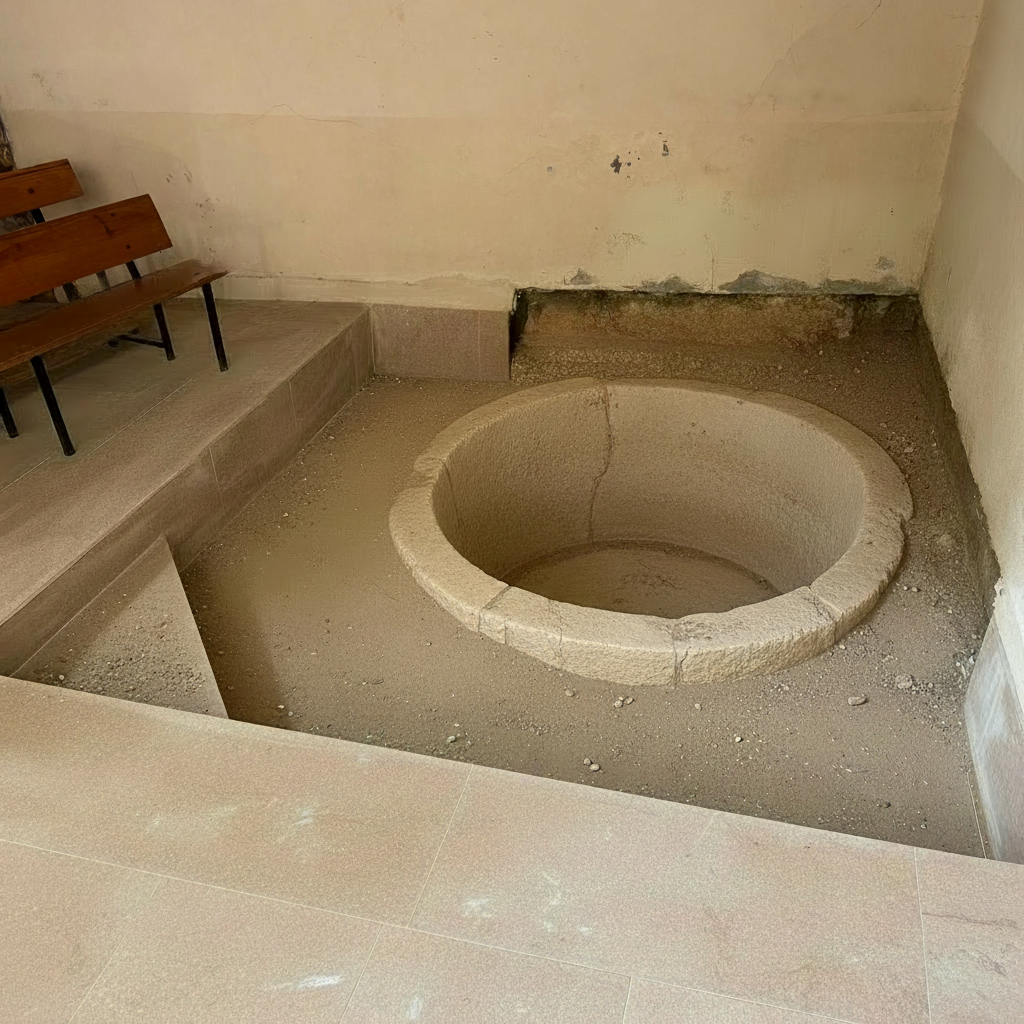
The most significant feature is found at the lower level, where a perfectly regular inner cylinder is clearly visible, with a smooth, rounded, and uniform surface. The finish shows traces of ancient manual workmanship and cannot be attributed to a casual accumulation of earth or loose stones.
The precise and continuous cylindrical form confirms that the interior was deliberately excavated or carved into the stone, constituting a true chamber designed to hold water. This type of execution is incompatible with improvised or domestic solutions and responds to a conscious and specialized liturgical design.
The combination of a deeply carved and regular interior with an outer envelope reinforced by stone rings and masonry fills is characteristic of ancient immersion baptismal fonts. In these structures, the inner chamber ensured watertightness and ritual use of the water, while the outer rings and fills allowed for level adjustment, structural reinforcement, and adaptation of the font to successive architectural modifications.
This construction system fully coincides with documented examples in the northern Iberian Peninsula, especially in areas of León, Palencia, and Asturias, and reinforces the interpretation of the find as an early medieval baptismal font reused or transformed in later phases.
A particularly relevant aspect is its integration into the later fabric of the church, being attached to walls built subsequently and partially concealed by modern and contemporary additions and renovations. This superposition of phases demonstrates that the structure predates the current walls and was respected, buried, or adapted over the centuries, allowing for the reconstruction of a continuous historical sequence of the liturgical space.
In the context of the province of León and its immediate surroundings, the widespread adoption of baptismal fonts associated with the definitive abandonment of immersion baptism is concentrated mainly throughout the 12th century and the first decades of the 13th, a period that coincides fully with the chronology of the sculptures preserved in the church of Villacil, particularly the Gothic carving of the Virgin. The presence of this Marian image, together with other sculptural and decorative elements of the church, confirms an intense phase of construction and liturgical activity at that time, during which the building was adapted to new ritual forms without abandoning earlier structures. In this sense, the baptismal font shows clear signs of reuse and transformation in later phases, probably from the 15th century onward, when liturgical and architectural reforms required the modification or decommissioning of former baptismal spaces, integrating them into a new internal organization of the church that reflects the evolution of religious practice over time.
Taken as a whole, the baptismal structure of Villacil constitutes an exceptional material testimony to early Christian continuity in La Sobarriba. Its rarity in a rural context, its technical complexity, and its good state of preservation make it an element of high heritage value, capable of placing the origin of the church several centuries earlier than its current configuration and of offering a comprehensive reading of the evolution of the baptismal rite and religious architecture in the region.
Baptismal Font of Villacil
Notable historical and heritage significance
In Late Antique and Early Medieval Hispania (4th–7th centuries), baptism was carried out predominantly by full immersion, generally administered to adults. For this purpose, independent baptisteries were built, separated from the main church, with circular, octagonal, or square plans, large pools excavated into the ground, and water drainage systems. These spaces, charged with strong symbolic meaning, were associated with the idea of baptism as death and resurrection, descent and rebirth, and constituted true ritual buildings.
From the 8th to the 11th centuries, coinciding with the progressive and complete Christianization of the population and the generalization of infant baptism, the rite of immersion gradually lost prominence. This shift brought about a decisive transformation in baptismal architecture: large baptisteries ceased to be built, and many of their structures were abandoned, reused, or altered. In their place, smaller baptismal fonts began to appear, adapted to baptism by infusion or aspersion.
From the 11th century onward, and especially during the 12th and 13th centuries, the Romanesque baptismal font as we know it today became established in Spain: massive stone vessels, generally circular, raised on a pedestal and located within the church space. These fonts were decorated with a rich symbolic repertoire—rope mouldings, arcades, vegetal motifs, or figurative scenes—and were fully integrated into the architecture of the church, typically near the entrance, emphasizing baptism as the gateway to the Christian community.
In many rural areas, particularly in the northern Iberian Peninsula, this process was not abrupt but gradual. In numerous cases, former immersion baptisteries were reused as the base for new Romanesque fonts, preserving subterranean structures, stone rings, or hydraulic systems that today allow the liturgical evolution of the building to be reconstructed. These reutilizations make certain fonts and bases exceptional testimonies of ritual continuity spanning several centuries.
The structure discovered beneath the pavement of the church of Villacil corresponds to a liturgical installation of notable antiquity and exceptional interest for the study of the Christian origins of the building and the evolution of the baptismal rite in the rural context of León. It consists of a stone construction with a circular or oval plan, made of limestone, composed of two concentric rings and a central opening that connects to a lower cavity carved directly into the bedrock.
The structure has an approximate external diameter of two metres and a central ring of about eighty centimetres, with a visible depth of nearly seventy centimetres, although its original depth must have been greater, as indicated by its partial burial. The presence of a water drainage opening confirms its functional conception related to the handling of water, an indispensable element in baptismal rituals, whose destination was always consecrated ground.
The overall morphology of the ensemble—concentric plan, deep chamber, drainage system, and intermediate platform—fully corresponds to immersion baptismal fonts characteristic of the Early Middle Ages, used between the 6th and 10th centuries, when baptism was performed by partial or total immersion, usually of adults. This type of structure predates the introduction of elevated Romanesque fonts and implies the existence of a stable and organized Christian community at a very early stage.
Analysis of the interior confirms the technical complexity and deliberate construction of the ensemble, ruling out functional interpretations unrelated to the liturgical sphere.
In the upper part of the interior, a crown of rough masonry can be observed, formed by irregular, uncut stones of varying sizes and natural shapes. These elements are set with reddish clayey earth, without the use of lime mortar, indicating a filling system intended to level and stabilize the structure.
This type of masonry does not respond to decorative criteria or to a monumental execution intended to be visible, but rather to a purely structural function: it serves as a transition between the outer body of the font and the inner chamber, ensuring proper load distribution. Its presence rules out the possibility of a Roman or Visigothic decorative basin and clearly points to a functional construction solution typical of early medieval contexts.
The most significant feature is found at the lower level, where a perfectly regular inner cylinder is clearly visible, with a smooth, rounded, and uniform surface. The finish shows traces of ancient manual workmanship and cannot be attributed to a casual accumulation of earth or loose stones.
The precise and continuous cylindrical form confirms that the interior was deliberately excavated or carved into the stone, constituting a true chamber designed to hold water. This type of execution is incompatible with improvised or domestic solutions and responds to a conscious and specialized liturgical design.
The combination of a deeply carved and regular interior with an outer envelope reinforced by stone rings and masonry fills is characteristic of ancient immersion baptismal fonts. In these structures, the inner chamber ensured watertightness and ritual use of the water, while the outer rings and fills allowed for level adjustment, structural reinforcement, and adaptation of the font to successive architectural modifications.
This construction system fully coincides with documented examples in the northern Iberian Peninsula, especially in areas of León, Palencia, and Asturias, and reinforces the interpretation of the find as an early medieval baptismal font reused or transformed in later phases.
A particularly relevant aspect is its integration into the later fabric of the church, being attached to walls built subsequently and partially concealed by modern and contemporary additions and renovations. This superposition of phases demonstrates that the structure predates the current walls and was respected, buried, or adapted over the centuries, allowing for the reconstruction of a continuous historical sequence of the liturgical space.
In the context of the province of León and its immediate surroundings, the widespread adoption of baptismal fonts associated with the definitive abandonment of immersion baptism is concentrated mainly throughout the 12th century and the first decades of the 13th, a period that coincides fully with the chronology of the sculptures preserved in the church of Villacil, particularly the Gothic carving of the Virgin. The presence of this Marian image, together with other sculptural and decorative elements of the church, confirms an intense phase of construction and liturgical activity at that time, during which the building was adapted to new ritual forms without abandoning earlier structures. In this sense, the baptismal font shows clear signs of reuse and transformation in later phases, probably from the 15th century onward, when liturgical and architectural reforms required the modification or decommissioning of former baptismal spaces, integrating them into a new internal organization of the church that reflects the evolution of religious practice over time.
Taken as a whole, the baptismal structure of Villacil constitutes an exceptional material testimony to early Christian continuity in La Sobarriba. Its rarity in a rural context, its technical complexity, and its good state of preservation make it an element of high heritage value, capable of placing the origin of the church several centuries earlier than its current configuration and of offering a comprehensive reading of the evolution of the baptismal rite and religious architecture in the region.

Rutas y Actividades
Descubre la Sobarriba a través de un recorrido inolvidable por su patrimonio, cultura y paisajes. La Ruta Cultural de la Sobrarriba ofrece visitas guiadas y explicaciones detalladas en varios puntos de interés, combinando historia, arquitectura, tradiciones y naturaleza en una experiencia única.
Cada ruta está diseñada para adaptarse a diferentes tipos de viajeros: desde caminantes y ciclistas hasta quienes prefieren rutas a caballo o incluso en globo aerostático. Acompáñanos en un viaje en el tiempo y adéntrate en los secretos de una tierra que ha sido testigo de siglos de historia.

Rutas y Actividades
Descubre la Sobarriba a través de un recorrido inolvidable por su patrimonio, cultura y paisajes. La Ruta Cultural de la Sobrarriba ofrece visitas guiadas y explicaciones detalladas en varios puntos de interés, combinando historia, arquitectura, tradiciones y naturaleza en una experiencia única.
Cada ruta está diseñada para adaptarse a diferentes tipos de viajeros: desde caminantes y ciclistas hasta quienes prefieren rutas a caballo o incluso en globo aerostático. Acompáñanos en un viaje en el tiempo y adéntrate en los secretos de una tierra que ha sido testigo de siglos de historia.