In Villavente, the oldest and most eloquent piece is not an altarpiece, but a baptismal font formed from an ancient Corinthian capital, likely Mozarabic, which has survived since the 10th century as a silent remnant of a far broader past.
In Villavente, the oldest and most eloquent piece is not an altarpiece, but a baptismal font formed from an ancient Corinthian capital, likely Mozarabic, which has survived since the 10th century as a silent remnant of a far broader past. The church, austere and functional, houses a Renaissance altarpiece with a Gothic Virgin and fragments of a Mudéjar coffered ceiling. Yet its true wealth lies in what is not displayed: documents revealing an unbroken history since the year 906, with donations, wills and land records that bind this place to a network of faith and memory. The 18th-century land registry and Madoz’s 1835 account confirm a modest yet constant village, where history resides in discreet objects and architecture that makes no attempt to dazzle. In Villavente, heritage does not impose—it waits to be discovered.
The church, austere and functional, houses a Renaissance altarpiece with a Gothic Virgin and fragments of a Mudéjar coffered ceiling. Yet its true wealth lies in what is not displayed: documents revealing an unbroken history since the year 906, with donations, wills and land records that bind this place to a network of faith and memory. The 18th-century land registry and Madoz’s 1835 account confirm a modest yet constant village, where history resides in discreet objects and architecture that makes no attempt to dazzle. In Villavente, heritage does not impose—it waits to be discovered.

Sometimes, a holy water font holds more history than an entire altarpiece. In Villavente, the oldest—and most unlikely, most resonant—object is a Corinthian capital. It rests on no column and supports no architrave. It is hollowed within, carved outside, and has received holy water for centuries. They say it once formed part of something grander: perhaps a Mozarabic church, maybe from Villarnorros de las Regueras, that vanished enclave by the Torío, whose memory now lingers only in scattered stones. The font—or the capital now serving as one—has not been precisely dated, but its form, its carving, its very presence link it to the 10th century, to a world no longer seen yet still shaping the visible. Embedded in a later church, it remains like a message that has never ceased speaking, though no one translates it now.
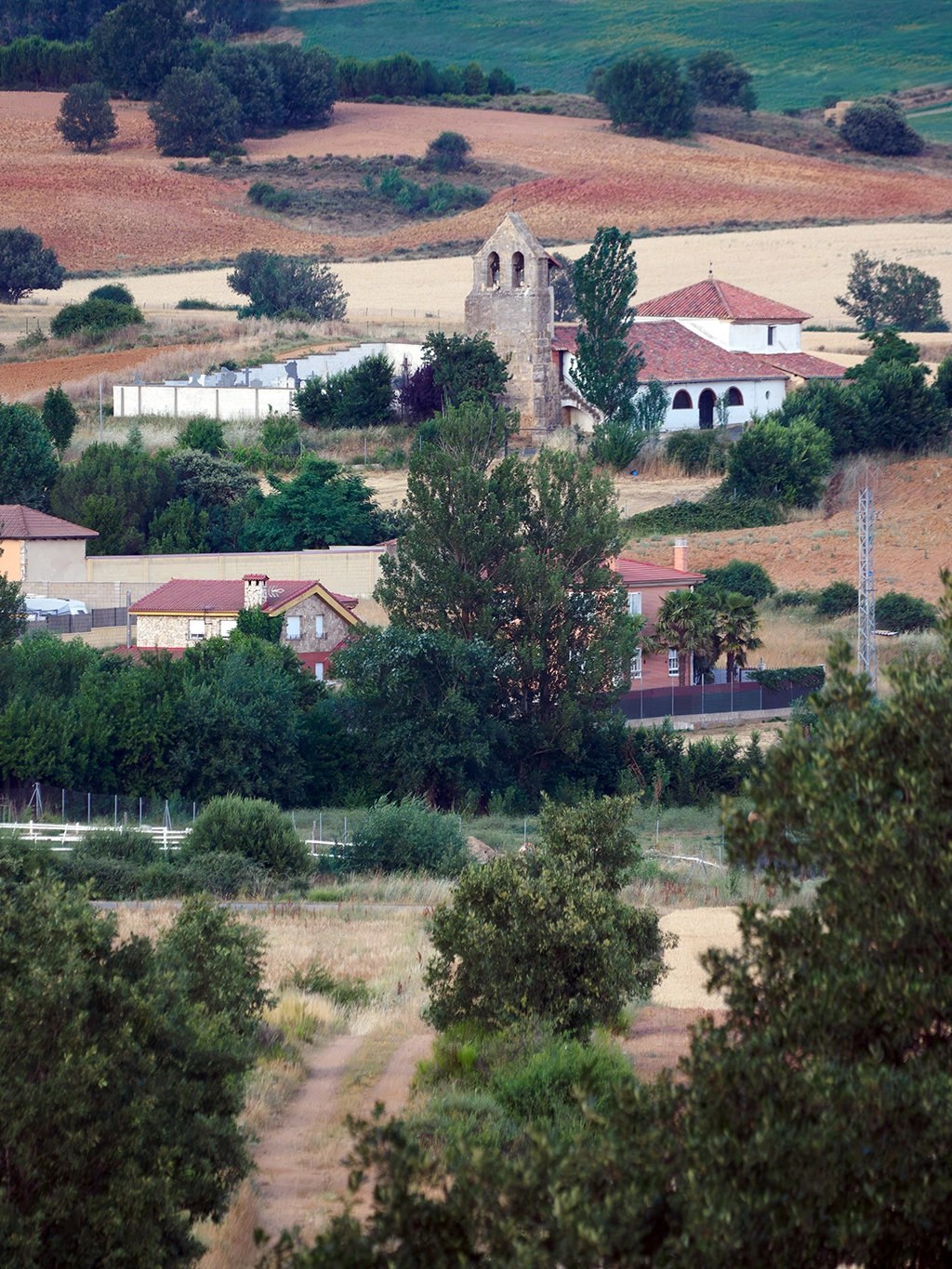
The present-day church of Villavente stands atop a hill that offers its walls and rooftops as tribute to the plateau. It follows the sober pattern of 16th-century Leonese churches: a single nave, a covered atrium to shield against the wind, and a raised apse that asserts itself more through structure than ambition. Nothing here seeks prominence; everything seems built to endure, not to impress.
Inside, it is silence that leads the gaze. Not guides—it leads. One proceeds toward the Renaissance altarpiece, where a Virgin and Child—dating from the late 15th or early 16th century—still holds the Gothic verticality and a gentle, almost pensive expression that needs no ornament to convey devotion. Below her, a tabernacle with rough yet intense reliefs presents the Resurrection; its door still pulses with a contained energy, revealed slowly.
High in the presbytery, fragments of the original Mudéjar ceiling hang on, cracked and endangered. But they endure. As if sacred carpentry—this unsigned art—knew its place lies between the divine and the common. For ceilings, like stones, also tell the story of belief.
And yet, Villavente’s most revealing feature is not what it shows, but what it quietly guards: scattered documents across the centuries that form a constellation of names, properties, liturgies and disputes.
As early as the year 906, King Alfonso III and Queen Jimena donated various estates to the Church of León, including Villa Aventi—none other than Villavente. In 1023, Ariulfo and his daughter sold a vineyard here, and in 1032, King Vermudo II granted the estate to Bishop Servando. Later, in 1127, Sancha, daughter of Queen Urraca, bestowed lands linked to the title of San Pelayo in this place. In 1235, a canon bequeathed his possessions in Villavente so that prayers would be said for him in perpetuity. The 13th century documents further wills, donations and land registers.
By the 14th century, the surnames of Leonor García de la Vega and her son Sancho García appear associated with Golpejar, Tendal and Villavente. They donate lands, vineyards, houses, orchards; they reserve usufructs and establish memorial anniversaries. All in solemn script, all imbued with the will to endure through ritual. The Chapter of León administers, redistributes, rents. Villavente forms part of this economy of eternity, where faith is measured in maravedís.
By 1753, the land survey of the Marqués de la Ensenada records the tangible: tithes of wheat, rye, lambs, wool and wine; seventeen houses standing, three in ruins; daily wages (two reales without meals), a leased tavern and the tailoring workshop of Manuel Gamonal and his son Juan. Oxen, cows, sheep, beehives, pigs and donkeys are listed. The priest, José de Villacorta, lives with his niece, a maid and a servant. The parish still collects first fruits. Everything is noted. Everything adds up. Nothing is excessive.
In 1835, Madoz describes the village as sloped, with wide views, a healthy climate, a primary school, and a church served by a priest. It grows flax, vegetables, potatoes, and raises livestock. It has little, but it has what it needs. It has permanence.
And that is what Villavente offers: a quiet permanence, made of fragments—Gothic, Mozarabic, Baroque—of legal and liturgical traces, of coffered ceilings barely hanging on, of fonts that were once capitals. As if here, in this sober church atop the hill, history had chosen to mingle without hierarchy, without seeking dominance.
Because in Villavente, as in places that do not announce themselves, heritage is not displayed. It allows itself to be found.
Sometimes, a holy water font holds more history than an entire altarpiece. In Villavente, the oldest—and most unlikely, most resonant—object is a Corinthian capital. It rests on no column and supports no architrave. It is hollowed within, carved outside, and has received holy water for centuries. They say it once formed part of something grander: perhaps a Mozarabic church, maybe from Villarnorros de las Regueras, that vanished enclave by the Torío, whose memory now lingers only in scattered stones. The font—or the capital now serving as one—has not been precisely dated, but its form, its carving, its very presence link it to the 10th century, to a world no longer seen yet still shaping the visible. Embedded in a later church, it remains like a message that has never ceased speaking, though no one translates it now.
The present-day church of Villavente stands atop a hill that offers its walls and rooftops as tribute to the plateau. It follows the sober pattern of 16th-century Leonese churches: a single nave, a covered atrium to shield against the wind, and a raised apse that asserts itself more through structure than ambition. Nothing here seeks prominence; everything seems built to endure, not to impress.
Inside, it is silence that leads the gaze. Not guides—it leads. One proceeds toward the Renaissance altarpiece, where a Virgin and Child—dating from the late 15th or early 16th century—still holds the Gothic verticality and a gentle, almost pensive expression that needs no ornament to convey devotion. Below her, a tabernacle with rough yet intense reliefs presents the Resurrection; its door still pulses with a contained energy, revealed slowly.
High in the presbytery, fragments of the original Mudéjar ceiling hang on, cracked and endangered. But they endure. As if sacred carpentry—this unsigned art—knew its place lies between the divine and the common. For ceilings, like stones, also tell the story of belief.
And yet, Villavente’s most revealing feature is not what it shows, but what it quietly guards: scattered documents across the centuries that form a constellation of names, properties, liturgies and disputes.
As early as the year 906, King Alfonso III and Queen Jimena donated various estates to the Church of León, including Villa Aventi—none other than Villavente. In 1023, Ariulfo and his daughter sold a vineyard here, and in 1032, King Vermudo II granted the estate to Bishop Servando. Later, in 1127, Sancha, daughter of Queen Urraca, bestowed lands linked to the title of San Pelayo in this place. In 1235, a canon bequeathed his possessions in Villavente so that prayers would be said for him in perpetuity. The 13th century documents further wills, donations and land registers.
By the 14th century, the surnames of Leonor García de la Vega and her son Sancho García appear associated with Golpejar, Tendal and Villavente. They donate lands, vineyards, houses, orchards; they reserve usufructs and establish memorial anniversaries. All in solemn script, all imbued with the will to endure through ritual. The Chapter of León administers, redistributes, rents. Villavente forms part of this economy of eternity, where faith is measured in maravedís.
By 1753, the land survey of the Marqués de la Ensenada records the tangible: tithes of wheat, rye, lambs, wool and wine; seventeen houses standing, three in ruins; daily wages (two reales without meals), a leased tavern and the tailoring workshop of Manuel Gamonal and his son Juan. Oxen, cows, sheep, beehives, pigs and donkeys are listed. The priest, José de Villacorta, lives with his niece, a maid and a servant. The parish still collects first fruits. Everything is noted. Everything adds up. Nothing is excessive.
In 1835, Madoz describes the village as sloped, with wide views, a healthy climate, a primary school, and a church served by a priest. It grows flax, vegetables, potatoes, and raises livestock. It has little, but it has what it needs. It has permanence.
And that is what Villavente offers: a quiet permanence, made of fragments—Gothic, Mozarabic, Baroque—of legal and liturgical traces, of coffered ceilings barely hanging on, of fonts that were once capitals. As if here, in this sober church atop the hill, history had chosen to mingle without hierarchy, without seeking dominance.
Because in Villavente, as in places that do not announce themselves, heritage is not displayed. It allows itself to be found.

Discover Sobrarriba through an unforgettable journey through its heritage, culture and landscapes. The Sobrarriba Cultural Route offers guided tours and detailed explanations at various points of interest, combining history, architecture, traditions and nature in a unique experience.
Each route is designed to suit different types of travellers: from walkers and cyclists to those who prefer horse riding or even hot air ballooning. Join us on a journey through time and delve into the secrets of a land that has witnessed centuries of history.

Discover Sobrarriba through an unforgettable journey through its heritage, culture and landscapes. The Sobrarriba Cultural Route offers guided tours and detailed explanations at various points of interest, combining history, architecture, traditions and nature in a unique experience.
Each route is designed to suit different types of travellers: from walkers and cyclists to those who prefer horse riding or even hot air ballooning. Join us on a journey through time and delve into the secrets of a land that has witnessed centuries of history.