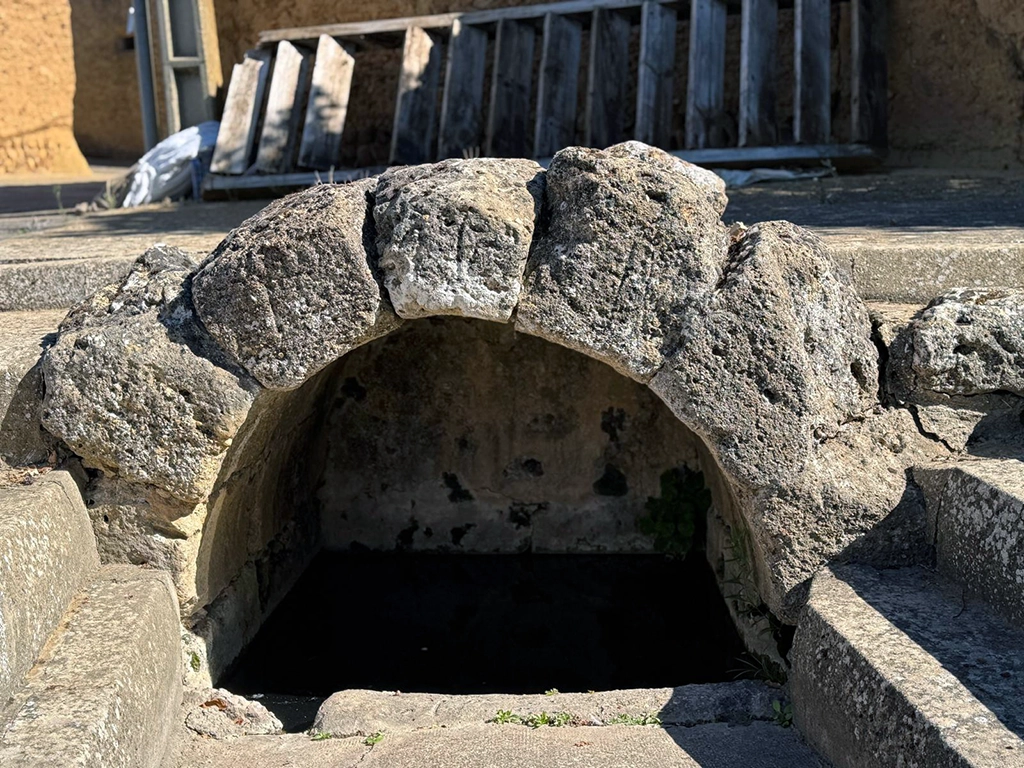
Since the year 990, there have been documented references to this village, and both the Cadastre of the Marquis of Ensenada (1753) and Madoz (1835) record a modest but persistent rural life: houses, vineyards, beehives, and rents that endure quietly. Navafría does not impress with what it displays, but with what it preserves without needing to show. An ideal place for travelers in search of what is authentic, hidden, and enduring without fanfare.
Since the year 990, there have been documented references to this village, and both the Cadastre of the Marquis of Ensenada (1753) and Madoz (1835) record a modest but persistent rural life: houses, vineyards, beehives, and rents that endure quietly. Navafría does not impress with what it displays, but with what it preserves without needing to show. An ideal place for travelers in search of what is authentic, hidden, and enduring without fanfare.
There are images that are not hidden, just overlooked. Not because they are shameful, nor because their time has passed, but because something in us—a blend of modesty, neglect, and forgetfulness—decides they are no longer urgent to behold. Navafría holds some of these images. They are not in showcases or central altars, but in a side room—more like a chamber one reaches not by intention but by mistake, or by instinct. There, as if withdrawn without surrender, rest four Baroque figures: Saint Peter, Saint James, and two mitred bishops—one possibly Saint Augustine—who wear their wear not as defeat but as a melancholic gravity, as if time, rather than eroding them, had consecrated them.

Beside them, two Rococo-style tables stand in silence. They do not seek attention. They simply are—like things that have survived too many priests, too many renovations, too many acts of forgetting. They no longer serve their original purpose, yet have not been discarded. And perhaps for that very reason, they mean more than many restorations: because they are still there.
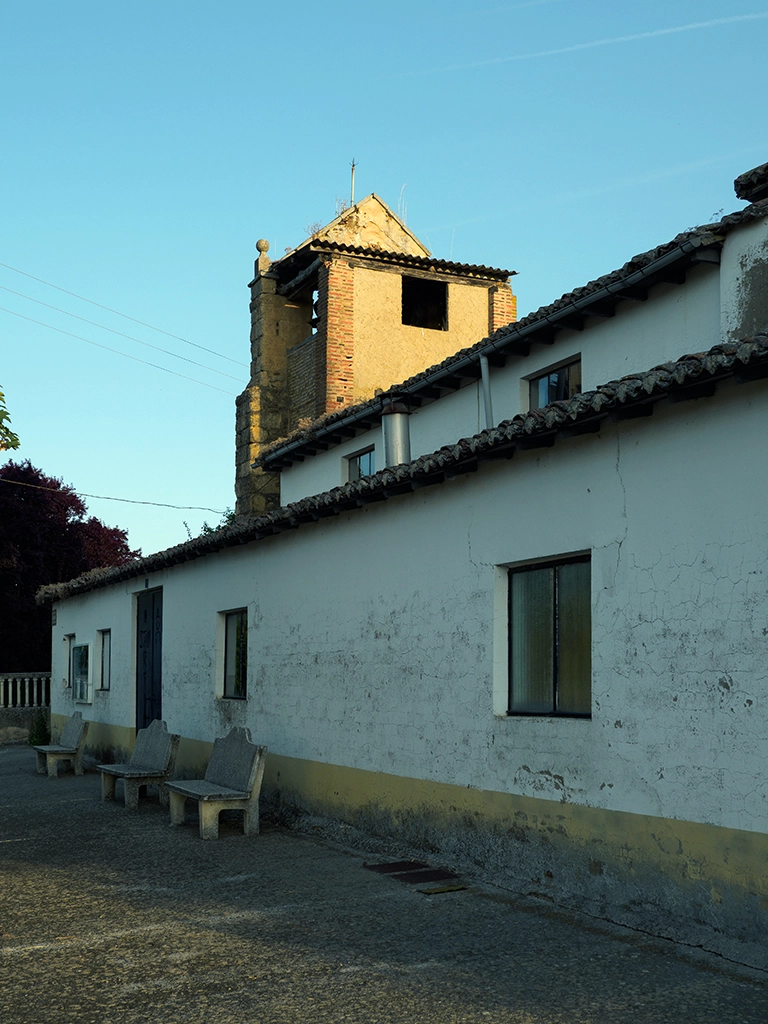
In Navafría, it is not the main nave that impresses—indeed, it lost its roof, and with it part of its soul—but rather what survives in spite of it all. The 18th-century bell gable still stands, alone, without walls to support it. One must see it from outside, against the sky, to understand that some vertical structures were not built to hold bells, but to hold one’s gaze—like a sign of dignity in the face of collapse.
And yet, inside there is an altar that seems to have forgotten this austerity. It is semi-oval, Baroque-Rococo, all curves and ornament, as if trying to compensate for the stripping away with exuberance. On it stand plaster statues—saints who were once wood, the flesh of old workshops—now presented with a manufactured decorum. Saint Martin, the patron of the village, is there, though not his true face. To find it, one must leave, seek it in a 16th-century panel attributed to the school of Bartolomé Fernández, now held in the museum of León Cathedral, as if what is essential could no longer live where it was born.
Only the tabernacle remains as a worthy witness. A Baroque jewel, embraced by Solomonic columns climbing like vine shoots, bunches of grapes carved as if the metaphor had taken bodily form. At its center, Saint John the Baptist appears in low relief, as if still reminding us: “This is the one who comes to prepare the way.” And one thinks, perhaps it is art, not faith, that has most faithfully fulfilled that mission.
There are contradictions in Navafría. As there are in everything that has not completely surrendered. The Renaissance Virgin holding the Child—who blesses with one hand and grasps the orb of the world with the other—has been repainted. Someone, no one knows who, decided to cover her face with new colors, pinks and blues, modern and hollow. And yet, below—at the base of the carving—the original gilding still breathes, as if waiting to be unearthed. For not everything can be completely hidden.
In 990, Navafría was already spoken of. The monk Pelayo, who bore the surname Zuleiman—a name that echoes like a fracture within the Christianity of his time—donated vineyards in the area. In 1010, the priest Servando sold a vineyard to his cousin Kaucta. And so, through the centuries, deeds, donations, wills, and claims have drawn not only the ownership of land, but the form in which this place has been inhabited by the desire to remain. Even when modernity presses in, when a school is built “seasonally”—as Madoz records in 1835—it is not what is added that endures, but what is retained.
The Cadastre of the Marquis of Ensenada, in 1753, lists thirteen neighbors, two widows, one other resident. Twenty-one houses. Two dovecotes. Three beehives. Rents, tithes, offerings—all are recorded with the precision of one who suspects that one day it might all cease to exist. But it hasn’t. Not entirely.
Navafría has neither been fully saved nor wholly lost. It lives on a tightrope stretched between centuries: one that believed faith could be clad in gilded wood, and another that has resigned itself to faking it with plaster. But it goes on. It fluctuates, yes. But it does not fall. And perhaps—that “perhaps” matters—it is this balance that is its deepest form of endurance: not glory, not ruin, but the steadiness that only certain places, and certain memories, manage to uphold without fuss.
There are images that are not hidden, just overlooked. Not because they are shameful, nor because their time has passed, but because something in us—a blend of modesty, neglect, and forgetfulness—decides they are no longer urgent to behold. Navafría holds some of these images. They are not in showcases or central altars, but in a side room—more like a chamber one reaches not by intention but by mistake, or by instinct. There, as if withdrawn without surrender, rest four Baroque figures: Saint Peter, Saint James, and two mitred bishops—one possibly Saint Augustine—who wear their wear not as defeat but as a melancholic gravity, as if time, rather than eroding them, had consecrated them.
Beside them, two Rococo-style tables stand in silence. They do not seek attention. They simply are—like things that have survived too many priests, too many renovations, too many acts of forgetting. They no longer serve their original purpose, yet have not been discarded. And perhaps for that very reason, they mean more than many restorations: because they are still there.
In Navafría, it is not the main nave that impresses—indeed, it lost its roof, and with it part of its soul—but rather what survives in spite of it all. The 18th-century bell gable still stands, alone, without walls to support it. One must see it from outside, against the sky, to understand that some vertical structures were not built to hold bells, but to hold one’s gaze—like a sign of dignity in the face of collapse.
And yet, inside there is an altar that seems to have forgotten this austerity. It is semi-oval, Baroque-Rococo, all curves and ornament, as if trying to compensate for the stripping away with exuberance. On it stand plaster statues—saints who were once wood, the flesh of old workshops—now presented with a manufactured decorum. Saint Martin, the patron of the village, is there, though not his true face. To find it, one must leave, seek it in a 16th-century panel attributed to the school of Bartolomé Fernández, now held in the museum of León Cathedral, as if what is essential could no longer live where it was born.
Only the tabernacle remains as a worthy witness. A Baroque jewel, embraced by Solomonic columns climbing like vine shoots, bunches of grapes carved as if the metaphor had taken bodily form. At its center, Saint John the Baptist appears in low relief, as if still reminding us: “This is the one who comes to prepare the way.” And one thinks, perhaps it is art, not faith, that has most faithfully fulfilled that mission.
There are contradictions in Navafría. As there are in everything that has not completely surrendered. The Renaissance Virgin holding the Child—who blesses with one hand and grasps the orb of the world with the other—has been repainted. Someone, no one knows who, decided to cover her face with new colors, pinks and blues, modern and hollow. And yet, below—at the base of the carving—the original gilding still breathes, as if waiting to be unearthed. For not everything can be completely hidden.
In 990, Navafría was already spoken of. The monk Pelayo, who bore the surname Zuleiman—a name that echoes like a fracture within the Christianity of his time—donated vineyards in the area. In 1010, the priest Servando sold a vineyard to his cousin Kaucta. And so, through the centuries, deeds, donations, wills, and claims have drawn not only the ownership of land, but the form in which this place has been inhabited by the desire to remain. Even when modernity presses in, when a school is built “seasonally”—as Madoz records in 1835—it is not what is added that endures, but what is retained.
The Cadastre of the Marquis of Ensenada, in 1753, lists thirteen neighbors, two widows, one other resident. Twenty-one houses. Two dovecotes. Three beehives. Rents, tithes, offerings—all are recorded with the precision of one who suspects that one day it might all cease to exist. But it hasn’t. Not entirely.
Navafría has neither been fully saved nor wholly lost. It lives on a tightrope stretched between centuries: one that believed faith could be clad in gilded wood, and another that has resigned itself to faking it with plaster. But it goes on. It fluctuates, yes. But it does not fall. And perhaps—that “perhaps” matters—it is this balance that is its deepest form of endurance: not glory, not ruin, but the steadiness that only certain places, and certain memories, manage to uphold without fuss.

Discover Sobrarriba through an unforgettable journey through its heritage, culture and landscapes. The Sobrarriba Cultural Route offers guided tours and detailed explanations at various points of interest, combining history, architecture, traditions and nature in a unique experience.
Each route is designed to suit different types of travellers: from walkers and cyclists to those who prefer horse riding or even hot air ballooning. Join us on a journey through time and delve into the secrets of a land that has witnessed centuries of history.

Discover Sobrarriba through an unforgettable journey through its heritage, culture and landscapes. The Sobrarriba Cultural Route offers guided tours and detailed explanations at various points of interest, combining history, architecture, traditions and nature in a unique experience.
Each route is designed to suit different types of travellers: from walkers and cyclists to those who prefer horse riding or even hot air ballooning. Join us on a journey through time and delve into the secrets of a land that has witnessed centuries of history.